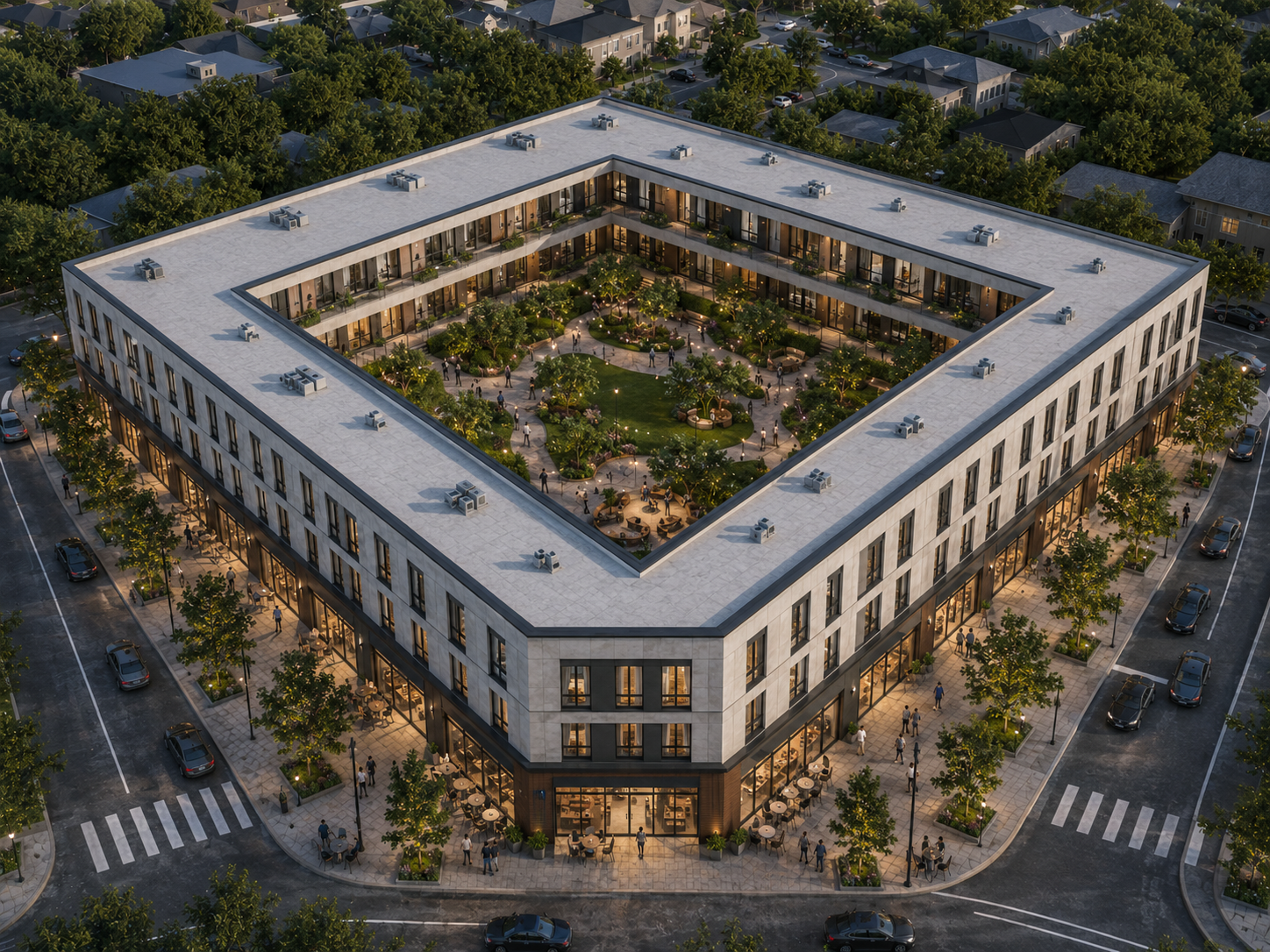
I imagine state-built residential complexes designed from the beginning as real social communities.
Not isolated blocks of flats.
Not anonymous towers.
Not buildings where people live next to each other but remain strangers.
I imagine modern apartment complexes of around 300 residences, housing about 1,000 people. The ground floor would have shops and useful services. The upper floors would have apartments arranged around a large shared inner courtyard. Each floor would work almost like a small neighborhood, where residents can meet naturally, safely, and without pressure.
The inner side of the building would not be just corridors. It would be shared “yard-like” space: open, visible, green, and continuous. Children could play safely. Parents could watch without fear. Elderly people could walk, sit, talk, and remain part of daily life. Neighbors could know each other, help each other, and build trust.
Today, many children grow up without siblings or without safe places to interact. Many elderly people end up isolated or are moved to nursing homes before they truly need to be. Many adults live surrounded by people but without community.
This design could change that.
Such a complex could include shared nurses, care assistants, a small clinic, childcare, common rooms, study spaces, gardens, workshops, guest rooms, and even a small nursing-home unit for residents who eventually need more support. The goal would not be to remove people from the community when they become weaker. The goal would be to bring care into the neighborhood.
It could also have community safety staff, not as surveillance, but as protection and support. A place where children, adults, and elderly people all feel safer because someone is nearby, visible, and responsible.
At this scale, residents could even elect their own local representative or small council. Not to control people, but to organize shared life: safety, care, events, children’s needs, elderly support, maintenance, gardens, and communication with the state.
This is why I believe the state must play a central role. The private sector may not want to take this risk, because many of the benefits are not immediate profit. But for society, the benefits could be huge: less loneliness, safer children, delayed nursing-home need, stronger local trust, better mental health, and lower long-term public costs.
The idea is simple:
We should not design housing only as private boxes.
We should design housing as social infrastructure.
A city of the future should not be a jungle of isolated flats. It should be built from human-scale communities where people can grow up, work, age, receive care, and belong.
Not “apartments with neighbors by accident.”
Neighborhoods by design.
Leave a Reply