Many times, we visit websites and we cannot understand who is behind them.
There are no legal terms. There is no clear country of origin. There is no responsible person, no company name, no real address, sometimes not even proper contact details. A site may publish claims, sell products, collect personal data, influence opinions, ask for money, or present itself as an authority — while hiding completely behind a domain name.
This is not a small technical problem. It is a problem of public responsibility.
The internet has become one of the main spaces where people receive information, buy services, form opinions, and make decisions. But in the physical world, responsibility usually has a name and an address. A shop has an owner. A newspaper has a publisher. A company has a legal base. A doctor, lawyer, consultant, or institution cannot simply appear from nowhere and demand trust.
Why should websites be different?
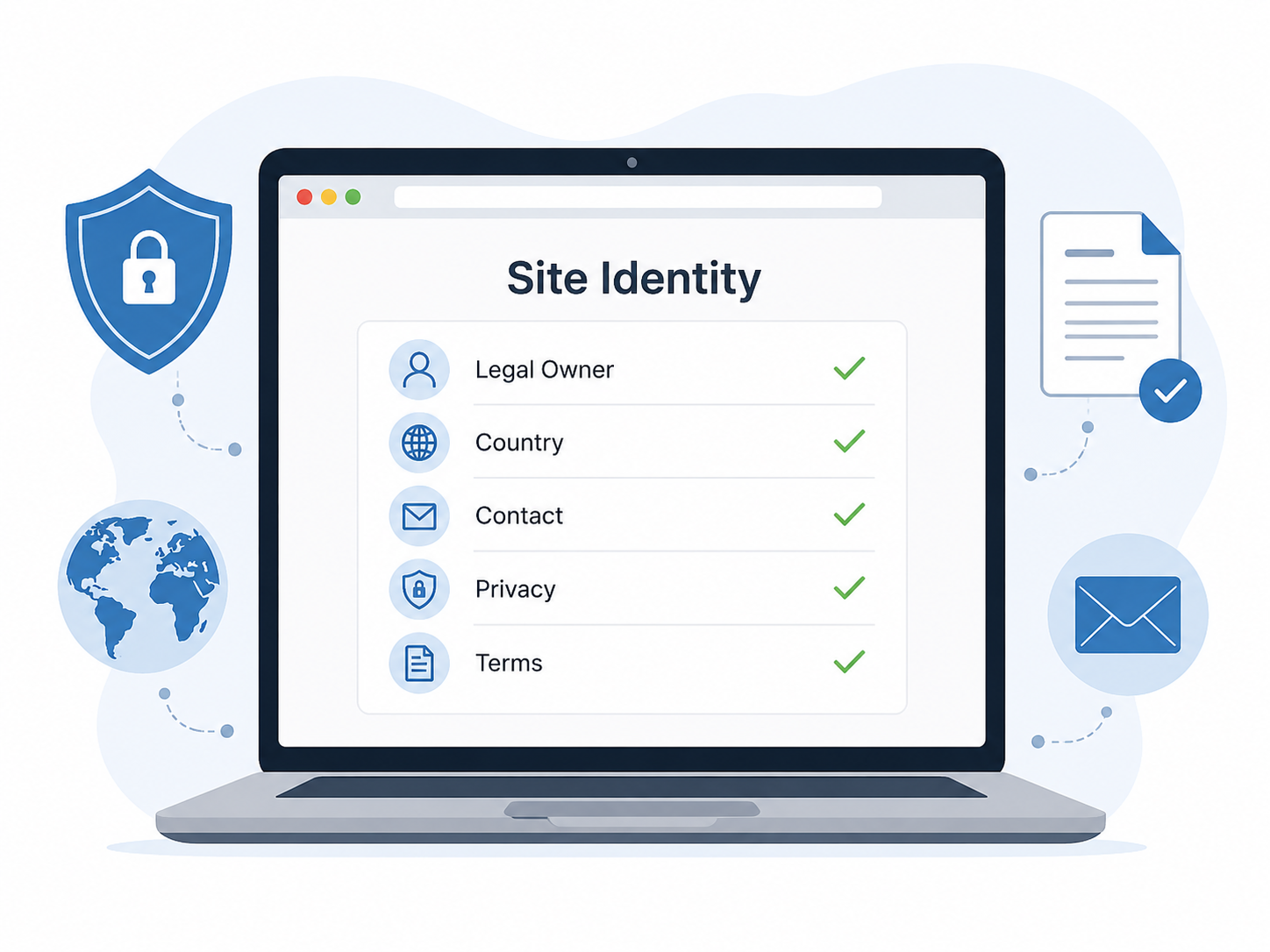
There should be a global standard requiring every serious website to have a clear and easy-to-find identity page. This page should not be hidden in small letters or written in confusing legal language. It should be simple, direct, and standardised.
It should say who owns or controls the site, the country under whose laws it operates, how someone can contact it, what terms apply, what privacy policy applies, and who is legally responsible for the content or service. If the site sells something, it should include consumer information. If it publishes news or serious claims, it should state editorial responsibility. If it collects personal data, it should explain clearly what it collects and why.
This should not be optional decoration. It should be part of the basic architecture of a trustworthy internet.
Search engines could play a decisive role. A website that does not provide this basic transparency should not enjoy the same visibility as a responsible website. At minimum, search engines should warn users or rank such sites lower. In stronger cases — especially commercial, manipulative, fraudulent, or mass-content websites — lack of identity should be enough to remove them from search visibility.
But this principle must be applied carefully.
There is a difference between anonymity and irresponsibility. Sometimes anonymity deserves protection. A person may write a personal blog about political oppression, illness, trauma, family problems, workplace abuse, religion, sexuality, or corruption. For such people, forced public identification could become a weapon against them. It could silence exactly the voices that society needs to hear.
So the goal should not be to destroy anonymity everywhere.
The better principle is this:
Protect anonymity for expression. Remove anonymity for power.
A small personal blog that only expresses personal thoughts does not need the same obligations as a company, news site, medical advice site, financial site, online shop, AI-generated content farm, or political propaganda machine. A private diary and a public influence operation are not the same thing.
However, even anonymous sites should not be completely unreachable when they cause serious harm. A possible compromise would be private verification. A blogger could remain publicly anonymous, but a trusted registry or legal authority could know who is responsible if there is fraud, defamation, criminal activity, or abuse. The public would see that the site is verified without necessarily seeing the person’s private identity.
This balances two values: freedom and responsibility.
Freedom matters because people must be able to speak without fear. Responsibility matters because no one should be able to manipulate, sell, deceive, collect data, or destroy reputations from behind a mask.
The internet needs a simple rule: the more power a website claims, the more transparent it must be.
If a website asks for money, it must say who receives it.
If it collects data, it must say who controls it.
If it gives advice, it must say who is responsible.
If it publishes news, it must say who stands behind the publication.
If it influences public opinion at scale, it must not hide like a private diary.
A standard identity page would not solve every online problem. It would not end fraud, propaganda, or manipulation. But it would create a basic line between responsible participation and irresponsible hiding.
The internet should not become a place where unknown actors can demand trust without offering accountability.
A person may have the right to speak anonymously.
But a powerful website should not have the right to influence society invisibly.
There can be freedom without chaos. There can be anonymity without impunity. And there can be an internet where every serious public actor has to answer one simple question:
Who are you, and under whose responsibility do you operate?
Leave a Reply