Modern education is built on a false beginning and a false ending.
It begins too late, as if the formation of a human being starts when a child first enters a classroom. And it ends too artificially, as if a person becomes ready for life after passing through years of passive schooling and a few decisive examinations.
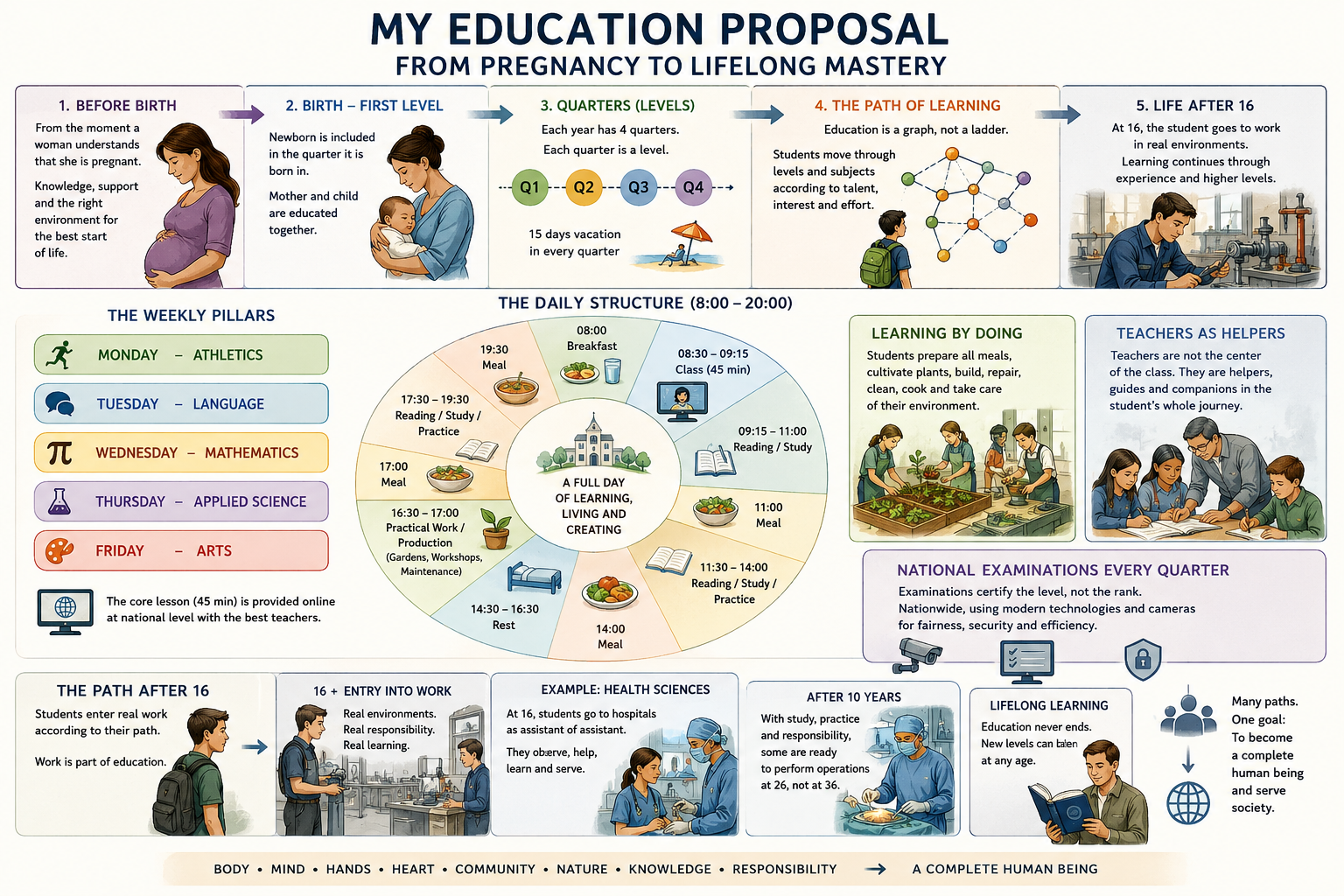
I propose a different view. Education should begin from the moment a woman understands that she is pregnant. It should continue from birth, through childhood, adolescence, work, and adult life. It should not be a narrow school system. It should be a complete system of human formation.
The purpose of education is not to produce students who can repeat information. It is to form human beings who can think, speak, count, work, cultivate, build, create, cooperate, defend, and find their own road.
From the moment of pregnancy, the mother must be given knowledge, support, and the right environment so that the embryo develops under the best possible conditions. Society must not wait until the child is six years old to become interested. The first educational responsibility begins before birth.
After birth, the newborn is included in the educational quarter into which it is born. This is the first level of education. At this stage, mother and child are educated together. The mother is supported, the child is observed and cared for, and education becomes part of life from the first day.
The basic unit of the system is the quarter. Every year has four quarters, and every quarter is a level. Each quarter includes 15 days of vacation. The old idea of a school “class” is abolished. Education is no longer a rigid staircase where all children of the same age are forced to move together. It becomes a graph: a network of paths, levels, subjects, talents, and choices.
Each educational subject has levels: 1, 2, 3, and so on. A student attempts a level. If they master it, they move forward. If they do not, they may try again later or choose another path. There is no humiliation in this. There is no permanent failure. There is only movement, discovery, and development.
The week has a clear structure.
Monday is dedicated to Athletics.
Tuesday is dedicated to Language.
Wednesday is dedicated to Mathematics.
Thursday is dedicated to Applied Science: physics, chemistry, biology, technology, engineering, agriculture, medicine, and every practical science of reality beyond language and mathematics.
Friday is dedicated to the Arts.
This structure is simple, but inside it the possibilities are enormous. The central lesson of the day lasts 45 minutes and can be provided online at national level. This means that the best available teaching material can reach every school. It also means that there can be hundreds of classes and levels, so that the system can adapt to the talents of each student.
Teachers, in this system, stop being the central authority standing in front of a class. They become helpers in the student’s whole effort to learn. They guide, support, explain, observe, encourage, correct, and help each student move through the graph of knowledge. The teacher is no longer the owner of the lesson. The teacher becomes the assistant of learning.
The school day runs from 8:00 in the morning to 8:00 in the evening. This may sound long only because we imagine school as passive sitting. But this is not passive schooling. It is a full educational community.
The day begins with breakfast at 8:00. Meals are also taken at 11:00, 14:00, 17:00, and 19:30. From 14:30 to 16:30 there is rest.
The students prepare the meals themselves, according to age and ability. They also cultivate as many plants as possible for use in those meals. The schoolyard should not be a dead cement surface. It should be a garden, a kitchen, a workshop, a place of production, maintenance, responsibility, and cooperation.
Children must learn to plant, cook, clean, repair, paint, build, use tools, maintain their environment, and serve the common life of the school. These are not secondary activities. They are part of education. A society that keeps children sterile for years and then complains that young people cannot do manual work has failed before it even begins to complain.
Every day includes the 45-minute central class and four hours of reading, study, practice, and guided work. Knowledge is not absorbed by listening alone. It must be worked on. It must be repeated, tested, applied, discussed, and connected with life.
Athletics is not entertainment. We cannot build skills on a sick or neglected body. The body must be trained, strengthened, disciplined, and respected. Sport, endurance, martial arts, and physical education are foundations of courage, confidence, and will.
Language is not only communication. It shapes perception. A person sees the world partly through the language they possess. Therefore, the mother tongue must be deeply cultivated, important international languages must be taught seriously, and older linguistic forms should be studied wherever they preserve deeper ways of thought.
Mathematics trains precision, structure, proof, relation, and abstraction. Without mathematics, the mind remains trapped in impressions.
Applied science connects the student with the material world. Physics, chemistry, biology, agriculture, medicine, engineering, and technology teach that reality has laws. Nature is not an opinion. Matter resists fantasy. This is an essential lesson.
The arts complete the human being. Music, drawing, theater, sculpture, architecture, dance, literature, and design cultivate expression, form, beauty, rhythm, and sensitivity. A civilization without art becomes mechanical. A person without art becomes poorer.
At the end of each quarter, there are national examinations for the relevant levels. These examinations do not exist to rank children permanently or to create one artificial final number. Their purpose is to certify whether a level has been mastered.
Modern technology can make this system efficient. Online platforms, secure digital examination systems, cameras, identity control, and national coordination can help create fair, transparent, and scalable examinations. The point is not to terrorize students. The point is to make the certification of levels reliable and nationally comparable.
The grade itself is not the important thing. The important thing is whether the level is acquired. Those who acquire it continue. Those who do not can try again in another quarter or later in life. One bad week, one illness, one family tragedy, one period of anxiety, or one moment of bad luck should not decide a human life.
By the age of 16, the student should not remain imprisoned in artificial schooling. At 16, the student begins to work.
This does not mean being thrown unprepared into the market. It means entering real fields of activity according to the levels already acquired. A student qualified for health sciences goes to hospitals. They do not perform operations. They start as the assistant of an assistant. They observe, help, serve, learn, and gradually enter the real environment of medicine.
After years of serious work, study, practice, examinations, and responsibility, some of them may perform operations at 26. Not at 36. A society that delays real responsibility for too long wastes human energy. Of course, responsibility must come gradually and safely. But it must come early enough for talent to mature inside reality, not outside it.
The same applies to other fields. The future engineer must enter real construction and technology. The future farmer must enter real cultivation. The future artist must enter real creation. The future lawyer must enter real legal work. The future teacher must enter real educational assistance. The future scientist must enter real laboratories and research environments.
Work is not the opposite of education. Work is part of education.
This is why the system must be lifelong. A person should be able to return to levels later in life. Education should not end at 18, 22, or 25. It should remain open. A human being changes. Talent appears late as well as early. The educational graph must remain available.
In this proposal, universities as we know them lose their old role. The future belongs to Research Centers. Their role is not merely to give degrees, but to produce research, create educational material, support the national teaching system, design levels, renew knowledge, and connect advanced learning with real work.
The philosophy behind all this is simple: education must stop being sterile.
It must stop separating the child from the body, from food, from nature, from language, from tools, from work, from responsibility, from community, from beauty, from courage, and from reality.
A real education begins before birth. It supports the mother. It welcomes the newborn. It forms the child through quarters of life and knowledge. It allows the student to move through a graph of paths. It uses national teaching material, local helpers, practical work, physical training, artistic cultivation, scientific thinking, and real examinations.
It does not ask every child to become the same person.
It gives every child the chance to find their road.
The aim is not merely to create professionals. The aim is to create complete human beings: people who can think, speak, count, cultivate, cook, build, repair, create, defend, cooperate, endure, and serve a living community.
Leave a Reply