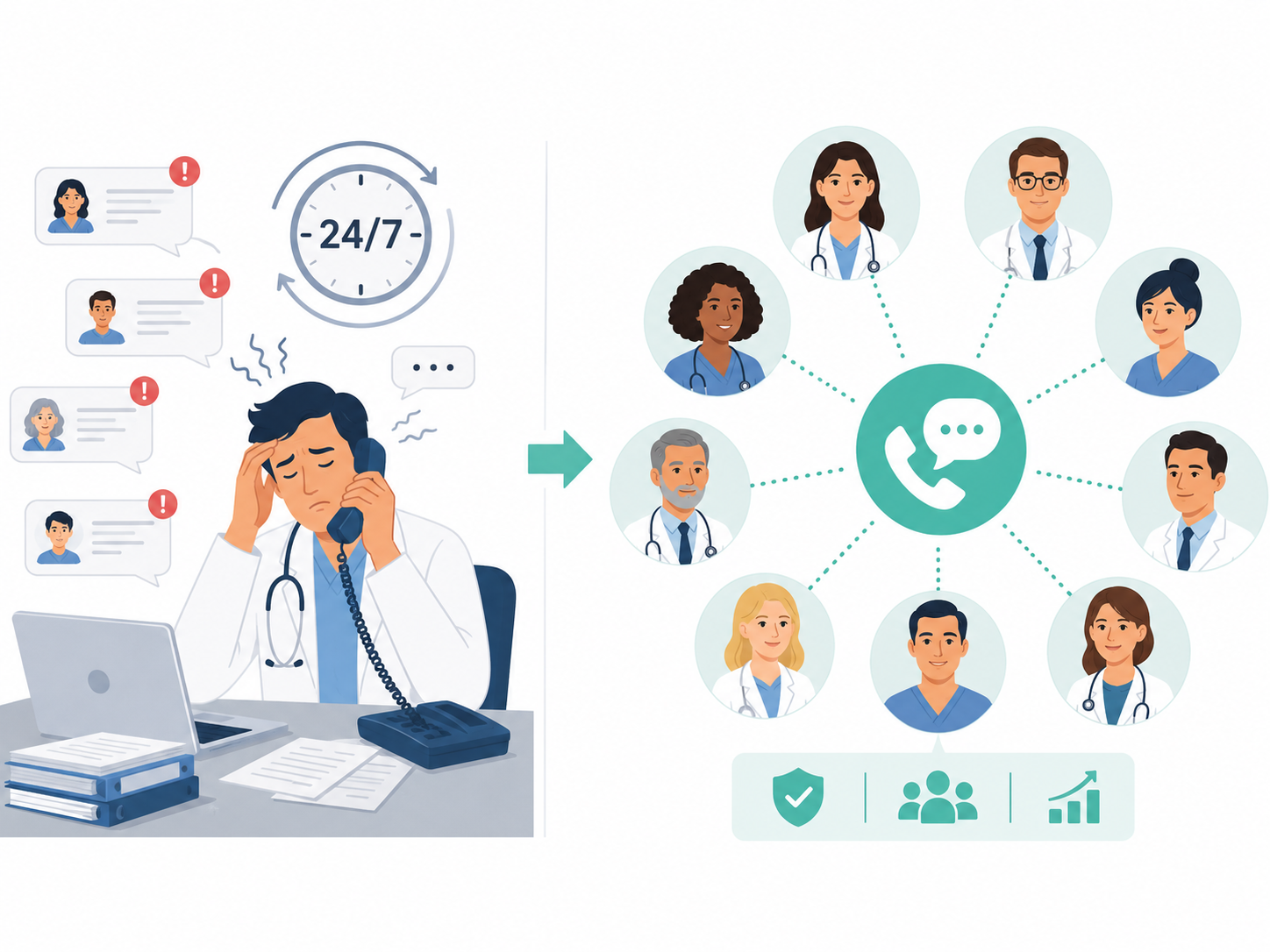
A strange contradiction exists in modern healthcare.
Doctors officially work specific hours. They may work eight hours in the morning, or they may work in shifts. On paper, their working day has a beginning and an end. But in reality, many doctors remain connected to their patients through private phone calls and messages every day of the year, at every hour of the day and night.
This is not a real healthcare system. It is an informal emergency system built on the personal sacrifice of doctors.
Patients are not satisfied either. They do not know when they should call. They do not know whether the doctor will answer. They do not know whether they are disturbing someone who is sleeping, working, driving, operating, or trying to rest. So the patient feels insecure, and the doctor feels trapped.
Healthcare should not depend on one exhausted doctor’s phone.
An emergency can happen at any time. Illness does not respect office hours. Fear does not wait for Monday morning. Pain does not wait for a doctor to finish dinner. It is crazy that a person in medical anxiety may have to wait even minutes before being received by the healthcare system.
This does not mean that every case can be solved instantly. Some cases need examination, tests, an ambulance, a hospital, or a specialist. But the first response must be immediate. The patient must know that the system has received the case and that someone officially responsible is acting.
For this reason, we should move from the model of one doctor per patient to the model of one stable medical team per patient.
My proposal is simple in principle: every patient should belong to a stable team of eight doctors, not to one isolated doctor. The patient should not experience this as eight different doctors. The patient should experience it as one medical identity: one team, one phone number, one message point, one shared patient record, one responsibility.
The active doctor at each moment would receive the calls and messages. The patient would not need to know which doctor is working. The patient would not collect eight phone numbers. The patient would not repeat the same story again and again. The team would share the medical record, the message history, the notes, the decisions, and the emergencies.
The structure could work like this.
Four doctors would permanently cover Monday to Friday in fixed six-hour periods:
2:00–8:00
8:00–14:00
14:00–20:00
20:00–2:00
The other four doctors would cover Saturdays, Sundays, all holidays, and the 60 annual leave days of the first four doctors, again in the same six-hour pattern.
This means that every doctor works six hours per day. That is not a luxury in healthcare. It is a necessity. Doctors need a clear mind. They must remember patients, judge symptoms, understand risk, and make decisions that may affect life and death. A tired doctor is not only an unhappy worker. A tired doctor is a danger created by bad organization.
The fixed time periods are also important. The doctor who works from 2:00 to 8:00 should always work that period. The doctor who works from 8:00 to 14:00 should always work that period. The system should not constantly rotate doctors from morning to afternoon to night. That destroys the body’s rhythm.
In this proposal, each doctor changes their biological rhythm only once. The night doctor adapts to night work. The morning doctor keeps a morning rhythm. The afternoon and evening doctors keep their own rhythm. This protects the health of doctors, their sleep, their family life, and their mental stability.
Payment should also recognize that not all hours have the same human cost.
A possible payment structure could be:
2:00–8:00: $12,000
8:00–14:00: $6,000
14:00–20:00: $9,000
20:00–2:00: $9,000
The morning period is the most natural working period for most people. The deep night period is the hardest. The afternoon and evening periods damage social and family life more than the morning period. A serious healthcare system should not pretend that all hours are equal. It should pay doctors according to the real biological and social burden of the hours they cover.
New technologies make this model far more realistic than it would have been in the past. Shared medical records, structured messages, internal notes, alerts, summaries, and artificial intelligence tools can help the active doctor understand the patient quickly. The system should not depend only on personal memory. It should combine stable human teams with strong technological continuity.
The greatest objection is obvious: this model needs far more resources.
But this is exactly the question society must answer. What are we willing to sacrifice in order to have real healthcare?
If we want continuous medical care, then we must move people, money, and attention from less important activities into health. We may need less consumption and more care. We may need fewer useless administrative layers and more doctors, nurses, assistants, and caregivers. We may need fewer resources spent on luxury, advertising, bureaucracy, and low-value services, and more resources spent on direct human protection.
A society cannot say that health is its first priority and then organize healthcare as if doctors were private 24-hour hotlines.
A civilized society should not leave patients alone in fear, and it should not leave doctors alone under permanent pressure.
The goal is not to make doctors work more. The goal is to organize care better. The goal is to protect patients without destroying doctors. The goal is to replace informal sacrifice with official responsibility.
One patient. One stable medical team. One contact point. Continuous care.
That is the direction healthcare should take.
Leave a Reply