Tax only the product that corresponds to equal time and equal risk
What is a fair tax?
At first sight, the answer seems simple. A fair tax is an equal tax. But this answer immediately creates a deeper question: equal according to what?
Equal money? Equal percentage of income? Equal sacrifice? Equal ability? Equal benefit received from the state? Equal consumption? Equal property? Equal social position?
Every tax system hides inside it a theory of equality. The problem is that this theory is rarely stated clearly. We argue about tax rates, deductions, exemptions, tax brackets, VAT, property taxes, corporate taxes, inheritance taxes, capital gains taxes, and income taxes, but we rarely ask the first question:
What is the fair basis of taxation?
A head tax is equal in one sense. If every citizen pays €2,000 per year, everyone pays the same amount. The basis of equality is the person’s existence: one head, one tax. But most people would reject this as unjust, because the burden is not the same for the poor person and the rich person. The equality is real, but the chosen basis of equality is wrong.
The old window tax gives another example. A house with more windows paid more tax. It was objective. Windows could be counted. But the result was absurd and cruel: people closed their windows to avoid taxation. Fiscal policy deprived people of light.
So objectivity is not enough. A tax can be easy to count and still be unjust. A tax can be equal in form and still unequal in substance.
The question remains:
What is the right basis of equality?
I propose this:
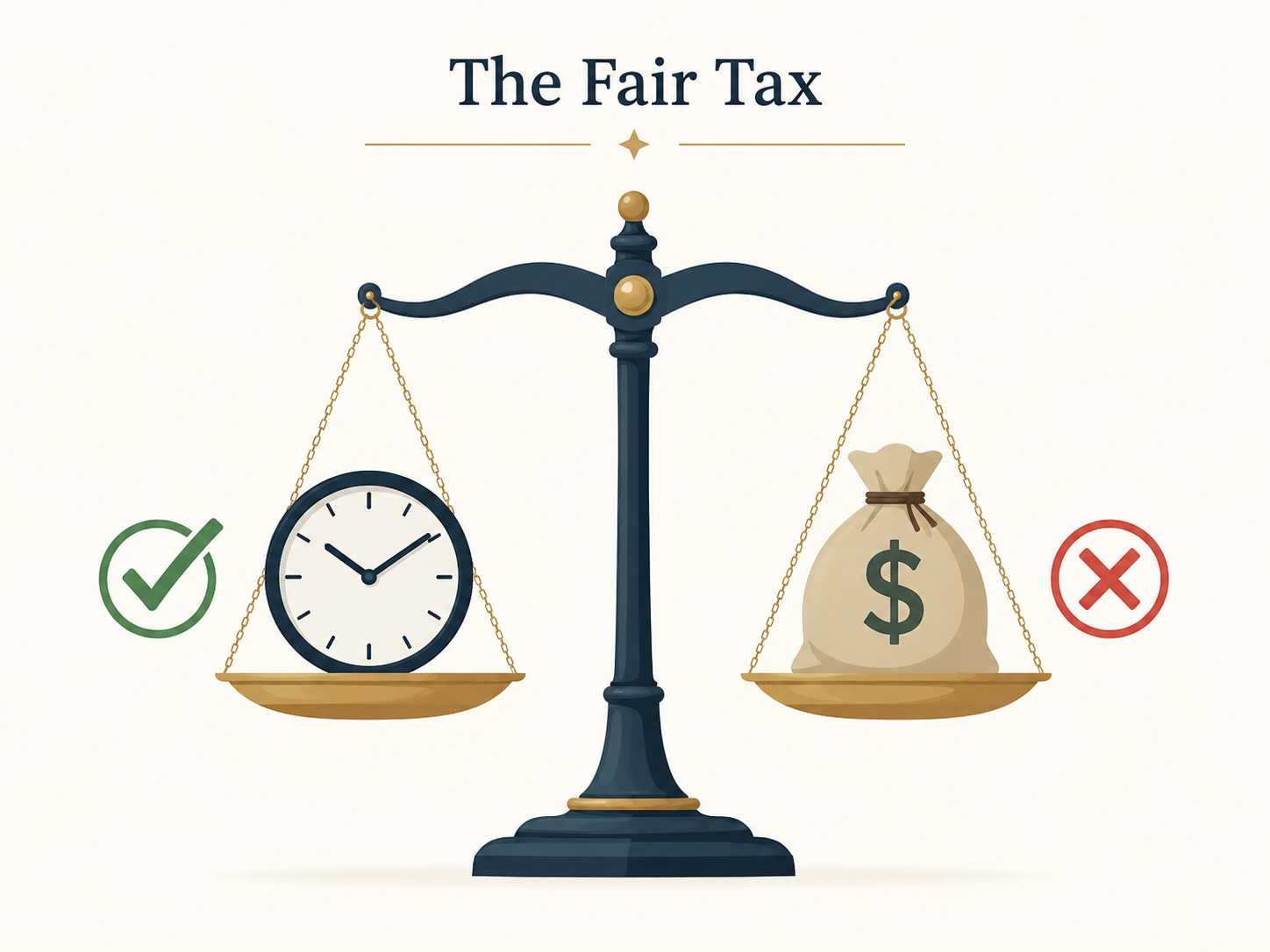
A fair tax is the product that corresponds to equal time and equal risk.
This is the core of the theory.
The citizen should not be taxed merely because he has income. He should not be taxed merely because he owns property. He should not be taxed merely because he consumed, inherited, invested, rented something, or succeeded in a risky activity.
The fair obligation of the citizen toward the common good must be based on something deeper and more universal:
the same time and the same risk.
The car in the field
Imagine four people traveling together in a car. The car leaves the road and enters a nearby field. The common goal is clear: the four people must return the car to the road.
This is their common good.
They all have different physical strength. One is strong, one is weak, one is old, one is young. If all four push the car, each will naturally contribute according to his strength. The stronger person will produce more force. The weaker person will produce less. But they will all do something equal:
they will push for the same amount of time.
That is the fair basis.
We would not say that the weaker person must push for three hours while the stronger person pushes for one hour, just because the weaker person produces less force. We would instinctively see that as unjust. The common effort should be shared through equal time, while allowing natural differences in capacity to produce different results.
This is the foundation of the fair tax.
The state is the common car. Public services, justice, safety, roads, defense, education, health, administration, social order: these are the common road to which the car must be returned.
Every citizen must contribute. But the contribution should not be measured only by money. Money is only the visible residue of deeper human realities: time, ability, risk, opportunity, power, and social position.
The fair civic obligation is not:
Everyone pays the same money.
Nor is it simply:
Everyone pays the same percentage of income.
It is:
Everyone contributes the product of the same civic time under the same civic risk.
Income is not the same as ability
Consider three people: A, B, and C.
Each earns €1,000 per month.
But A earns this income by working 4 hours.
B earns it by working 8 hours.
C earns it by working 16 hours.
Under the present system, if all other circumstances are the same, they are treated as equal. They have the same income, so they are expected to pay the same tax.
But are they really equal?
No.
A produces €1,000 in 4 hours.
B produces €1,000 in 8 hours.
C produces €1,000 in 16 hours.
Their income is equal, but their productive power is not equal.
If the fair tax is the product of 2 hours of work, then:
A should pay €500.
B should pay €250.
C should pay €125.
This result seems shocking only because we are used to thinking in terms of income. But in terms of time, it is completely logical.
A can produce €500 in 2 hours.
B can produce €250 in 2 hours.
C can produce €125 in 2 hours.
So each gives the same thing: the product of 2 hours of his productive capacity.
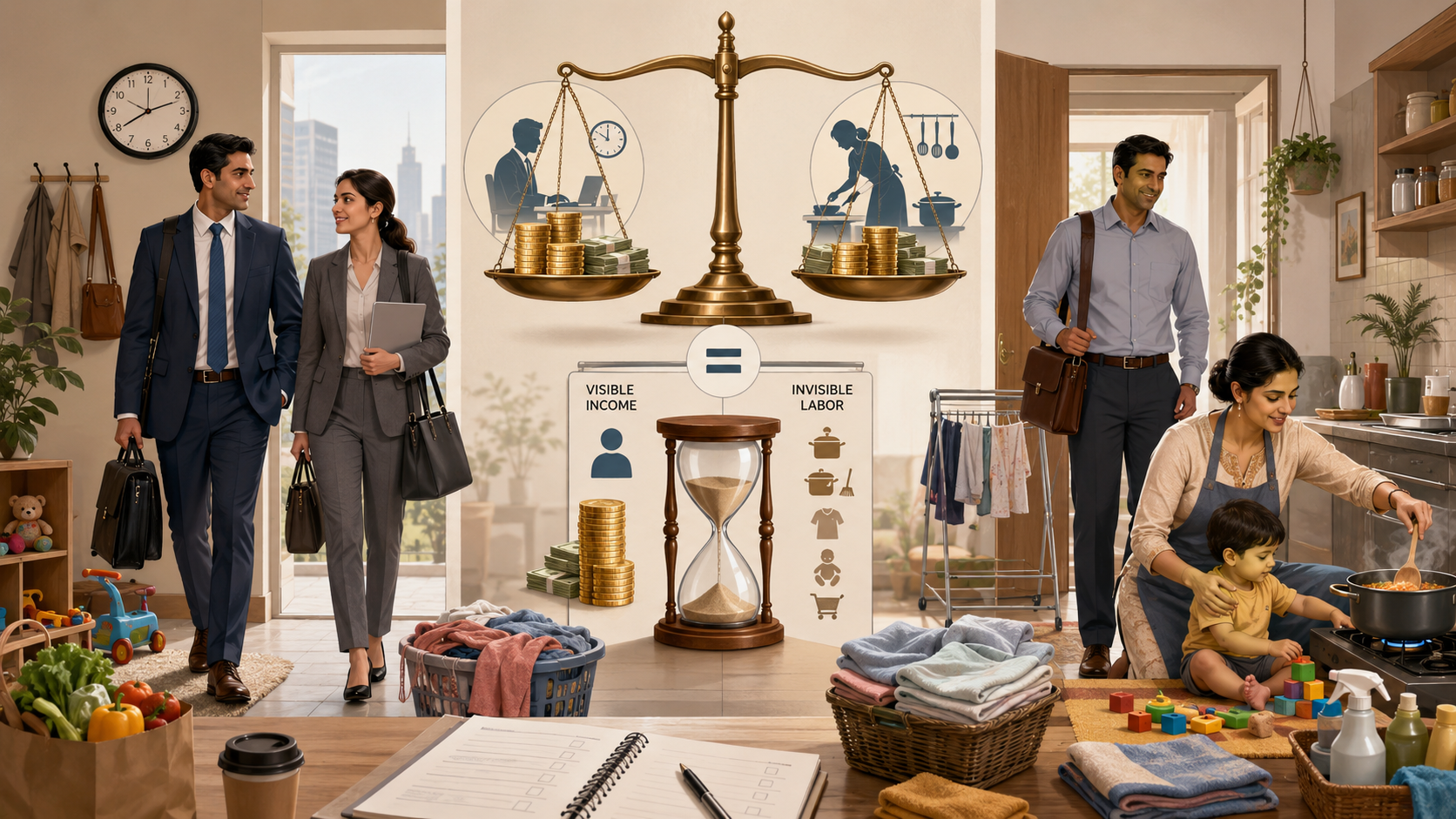
Today, the state taxes the final result: income. But income alone conceals the human cost behind it. Two people may have the same income, but one may have sacrificed four times more life to produce it.
In physical terms, the present system taxes work. It taxes the completed result.
But the fair tax should be closer to a tax on power: the ability to produce work per unit of time.
The distinction is essential.
A person who produces €1,000 in 4 hours is not in the same position as a person who produces €1,000 in 16 hours. To treat them as the same because their income is the same is not justice. It is blindness.
The problem of risk
But time is not enough.
A second element must be added: risk.
Some income is produced under certainty. Some income is produced under uncertainty. Some people work for a salary. Others invest, build businesses, take loans, buy stock, rent property, create products, employ workers, or enter markets where profit and loss are both possible.
Risk income cannot be treated like ordinary income.
If a person enters a risky activity, the average result may be zero. In some years he gains; in others he loses. If the state taxes the profitable years but does not pay negative taxes in the losing years, the state becomes an unfair partner.
It shares the upside but refuses the downside.
That is not justice.
If the state wants to tax risk profit as if it were ordinary income, then it should also participate in risk loss. If it does not compensate the loss, it has no moral right to claim a share of the profit.
The problem goes even deeper: risk cannot truly be quantified.
Even the person taking the risk often cannot measure it precisely. He may estimate, but he does not know. He does not know whether he will win or lose. He does not know how large the loss may be. He does not know whether profit came from skill, effort, timing, luck, hidden danger, or exposure to future loss.
The state sees only the result after the uncertainty has disappeared.
It says:
You made a profit. Pay tax.
But the citizen lived the uncertainty before the result.
That is the injustice.
The state does not stand beside the citizen in the fog. It arrives after the battle and demands a share of the victory.
Therefore the fair tax cannot be merely the product of equal time. It must be the product of equal time and equal risk.
Thus the principle becomes:
Tax only the product that corresponds to equal time and equal risk.
This is the fair proposition.
Why a fair tax cannot be estimated
Once we accept this principle, a dramatic conclusion follows.
A truly fair tax cannot be estimated by the usual methods.
Income can be declared or hidden.
Property can be valued or undervalued.
Consumption can be observed.
Bank accounts can be checked.
Invoices can be issued or avoided.
But the real elements of fairness — time, risk, ability, opportunity, and social power — cannot be measured accurately by the state.
The state cannot know how much life-time was truly sacrificed to produce an income. It cannot know the real risk behind a gain. It cannot know the hidden cost of a profession. It cannot know the future losses inside today’s profit. It cannot know whether two people with the same money are really equal in power.
So the modern tax system rests on an illusion. It pretends that income is a sufficient measure of taxable capacity. But income is only the visible surface.
The necessary measure of justice is deeper — and largely unknowable.
That is why the fair tax cannot be calculated from above.
The state cannot honestly say:
I know your fair tax.
It does not know.
So the system must be reversed.
Instead of the state estimating each citizen’s fair tax, the state must impose an equal civic obligation and allow citizens to reveal the value of avoiding that obligation.
The practical proposal
The practical solution is this:
Every person over 16 years old must provide 2 full days per week to public services.
These days are not chosen arbitrarily by the citizen. They are assigned randomly by an algorithm for the next 12 months, in a revolving manner.
At any moment, each citizen knows one year in advance which days he must serve. This makes planning possible. The obligation is equal, predictable, and universal.
But the citizen may exchange service days for money.
If he does not want to appear for public service on an assigned day, he may buy that day back.
The price of buying back days increases progressively.
For example:
1 day costs $60.
2 days cost $150.
3 days cost $300.
And so on.
The exact scale can be designed politically, but the principle is that each additional day becomes more expensive.
This creates a self-revealing system.
The state does not ask:
How much did you earn?
It asks:
Will you give the common time, or will you pay to keep it private?
Each person decides how many days to buy back. A poor person may give more time. A wealthy person may buy more days. A person whose private time is extremely valuable may buy many days. A person whose time has lower private value may serve.
The state no longer needs to discover the citizen’s true income. It no longer needs to distinguish between salary, rent, dividends, inheritance, business profits, stock gains, family money, or risky income.
The source of money becomes irrelevant.
Whether the money comes from a rich father, from rent, from stocks, from business, from salary, from luck, from reputation, or from accumulated power does not matter.
The question is only:
How much are you willing and able to pay in order to keep your time private?
In the end, the system taxes the power to have money — but not through declarations and investigations. It taxes it through revealed choice.
The end of tax evasion
This system also changes the problem of tax evasion.
In the present system, the citizen is asked to declare income, expenses, profits, losses, property, transactions, and economic activity. The entire system depends on information that can be hidden, distorted, delayed, transferred, or disguised.
Tax evasion exists because the tax base is hidden.
But civic time is not hidden.
Either the citizen appears for public service, or he buys back the day.
There is no need to prove whether he earned €10,000 or €100,000. There is no need to inspect invoices. There is no need to classify income. There is no need to decide whether a gain came from labor, capital, risk, inheritance, rent, or speculation.
The obligation is visible.
The citizen either gives the day or pays the official exchange price.
In this sense, tax evasion can be stopped at its root, because the hidden object of taxation disappears. The state no longer chases invisible income. It administers visible civic time.
A person cannot hide the fact that he did not appear for public service. And if he does not appear, he must have bought the day.
The tax base becomes public, simple, and unavoidable.
Why the exchange price must increase
The buy-back price must not be flat.
If every day could be bought for the same low amount, rich citizens would simply buy all days and the system would become another head tax. If every day had the same price, the rich would escape easily and the poor would serve.
The price must increase because each additional private day reveals greater power.
The first day may be cheap. The second more expensive. The third much more expensive. The citizen will continue buying days only until the marginal cost equals the value he attaches to keeping that day private.
This is the key mechanism.
The state does not estimate the citizen’s power. The citizen reveals it.
A person who buys many days is saying, through action:
My private time is worth more to me than this increasing public price.
That private value may come from money, work, family power, social influence, political opportunity, business opportunity, artistic creation, public reputation, or personal autonomy.
The system does not need to know which one.
It only observes the choice.
The journalist and the plumber
Consider a journalist and a plumber.
Suppose they earn the same income. Suppose they work the same number of hours. Suppose they face the same economic risk.
Will they buy the same number of public-service days?
Not necessarily.
The journalist may buy more.
Why?
Because the journalist may have more social power attached to free time. A free day may allow him to write, appear, influence, meet people, shape opinion, build reputation, create contacts, and increase future authority.
His free time has a social multiplier.
The plumber may earn the same money, but his work is more directly tied to practical service. To receive the same public attention or social influence, he may need to spend much more effort or money.
So two people with equal income are not necessarily equal in social power.
This reveals something very important: people do not only maximize income. They try to maximize social power.
Money is only one component of social power.
Other components include reputation, visibility, contacts, authority, access, freedom of movement, control over time, influence over narratives, proximity to institutions, and the ability to avoid obligations.
A normal income tax cannot see these things. It sees the journalist and the plumber as equal if their income is equal.
But the public-service exchange system may reveal the difference. The journalist may be willing to pay more to protect his private time because that time can be converted into influence. The plumber may not have the same conversion power.
So the system taxes something deeper than income:
the revealed power to convert private time into social advantage.
This is why the proposal is not merely a tax reform. It is a theory of society.
People seek social power, not only money
The modern tax system assumes that money is the main object. But in real life, people often seek something broader.
They seek power.
Money matters because it can buy comfort, freedom, protection, access, and status. But money is not the final object. It is a tool.
Some people accept lower income for higher prestige. Some accept risk for autonomy. Some seek public visibility. Some seek control over institutions. Some seek reputation. Some seek security. Some seek the ability to command the attention or labor of others.
Social power includes money, but it is not limited to money.
A person with moderate income but high visibility may possess more practical power than a person with higher income but no influence. A person with connections may solve problems that another person cannot solve with money alone. A person with public voice may convert one free day into opportunities that others could not buy easily.
Therefore, income is an incomplete tax base because income is an incomplete measure of power.
A fair tax system should not chase declared income as if it were the whole truth. It should reveal how much each citizen values exemption from common obligation.
The buy-back system does exactly that.
It says:
Here is your equal civic duty. If your private time is more valuable to you, buy it back.
This captures not only economic power, but also the broader power to make private time valuable.
Public service as the original tax
In this theory, money taxation is not the original obligation.
The original obligation is public service.
Money is only a substitute.
This is important.
Today we think of tax as money first. Citizens pay money, and the state hires people to perform public tasks. The citizen becomes distant from the common good. He contributes through abstraction.
But under the fair tax proposal, the primary duty is concrete:
Give time to the common good.
If you do not want to give time, then you may pay money instead.
This restores the connection between citizenship and service.
The unemployed person can contribute. The poor person can contribute. The rich person can contribute. The person with no declared income can contribute. The person with wealth hidden in family structures can contribute. The person with risky income can contribute without the state pretending to understand his risk.
Everyone stands before the same civic demand:
Two days per week belong to the public.
The rich may buy them. The poor may serve them. The powerful may reveal themselves by buying many of them. The socially ambitious may reveal the value of their private time. The hidden wealthy cannot hide behind zero declared income, because the obligation is not based on declared income.
Is this forced labor?
A critic may say that compulsory public service is forced labor.
The answer is that taxation is already compulsory labor in monetary form.
If the state taxes 25% of income, then in effect it takes a portion of the citizen’s working time. A person who works 8 hours and pays 25% tax has worked 2 hours for the state.
The difference is that the current system hides this behind money. The proposed system makes it honest.
It says openly:
The common good requires part of your time.
But it also gives an exit:
You may exchange that time for money.
Therefore the system is not a simple labor command. It is a civic obligation with a monetary alternative.
The real question is not whether the state takes time. Every tax takes time. The real question is whether the taking is fair, visible, and based on a defensible principle.
This proposal says that the fair basis is equal civic time, with equal civic risk, and voluntary monetary exchange.
What kind of public services?
The public-service days could be used in many ways.
Citizens could support hospitals, schools, elderly care, environmental work, local administration, civil protection, emergency preparation, digital archiving, cultural services, public maintenance, food distribution, disaster response, municipal services, and many other functions.
Not all citizens have the same skills or physical capacity. So the system should assign tasks according to ability, health, training, and social need.
The equality is not that everyone performs identical tasks. The equality is that everyone owes the same civic time.
Just as the four people pushing the car do not produce identical force, citizens in public service will not produce identical output. But they share the time obligation.
Some will produce more. Some less. Some will serve physically. Some intellectually. Some administratively. Some socially. Some digitally.
The state should organize the service rationally, but the moral base remains the same:
equal time for the common good.
Why this is fairer than income tax
Income tax punishes visible income and rewards invisible power.
It punishes those whose income is easy to observe. It struggles with those who can hide income, transform income, move income, delay income, or convert power into non-monetary advantages.
It also confuses different realities.
It treats labor income, risk income, inherited advantage, rent income, capital gains, and professional income as if they could all be placed into one moral category: taxable income.
But they are not morally identical.
The fair tax proposal avoids this confusion.
It does not need to know whether money came from work, capital, inheritance, rent, luck, risk, or family. It does not need to classify the source. It does not need to measure risk. It does not need to judge whether a person’s income reflects effort, ability, privilege, or uncertainty.
It begins from a universal fact:
Every citizen has time.
And then it adds:
Every citizen must give the same civic time, unless he pays to keep it private.
This is fairer because it is based on the common human condition before it is based on economic categories.
The moral center
The moral center of the proposal is simple:
A fair state should not guess the citizen’s hidden economic truth. It should not pretend to know the exact justice of income, risk, ability, and power. It should not tax only the visible result while ignoring the invisible conditions that produced it.
Instead, the state should impose an equal civic obligation and allow the citizen to reveal his own valuation of private time.
The citizen who has little money can serve.
The citizen who has much money can pay.
The citizen whose time produces high social power will likely pay more.
The citizen whose money comes from risk is not separately punished for a successful outcome.
The citizen with hidden wealth cannot escape, because the obligation exists even without declared income.
The unemployed person is not excluded from contribution, because contribution is not only money.
The state no longer asks everyone to reveal their economic soul. It asks them to make a simple choice:
Serve the common good with your time, or pay an increasing price to keep that time for yourself.
Conclusion
The fair tax is not a percentage. It is not a bracket. It is not a tax on windows, heads, houses, invoices, profits, or declarations.
The fair tax is a principle:
Tax only the product that corresponds to equal time and equal risk.
But because equal risk cannot be measured, and because income does not reveal true power, the state cannot calculate the fair tax directly.
So the fair tax must be applied indirectly.
Everyone receives the same public-service obligation: two full days per week. The days are assigned randomly and known one year in advance. Whoever wants to keep those days private may buy them back at an increasing price.
This system transforms taxation from a suspicious investigation of income into a visible civic choice.
It ends the central mechanism of tax evasion because the taxable base is no longer hidden income. It is public time.
It also reveals a deeper truth about society: people do not merely seek money. They seek social power. Money is only one part of that power. Time, reputation, influence, visibility, access, and autonomy may be equally or more important.
A fair tax system should therefore not look only at income. It should look at the citizen’s revealed willingness to sacrifice money in order to preserve private time.
Because private time is where power is created.
And the common good has a right to ask every citizen for the same thing:
not the same money,
not the same percentage,
not the same declared income,
but the same civic time under the same civic risk.
That is the fair tax.