Veganism is usually presented as a moral choice, a health choice, or an environmental choice. But there is another way to see it: veganism is often a result of bad education.
Not bad education in the narrow sense of poor grades or weak schools. Bad education in a deeper sense. An education that separates the human being from the natural processes that sustain life. An education that fills the mind with abstractions, slogans, and moral judgments, while leaving the hands empty of soil, tools, plants, animals, and real responsibility.
Modern society has become sterile. The schoolyard is often cement. The classroom is often closed. The child sees screens, books, plastic packages, supermarket shelves, and moral messages, but rarely sees a hen laying an egg, a goat giving milk, a bean growing from the soil, or a tomato plant needing care, water, sun, and protection.
How can a person judge food, animals, nature, and agriculture without having touched the chain of life that produces food?
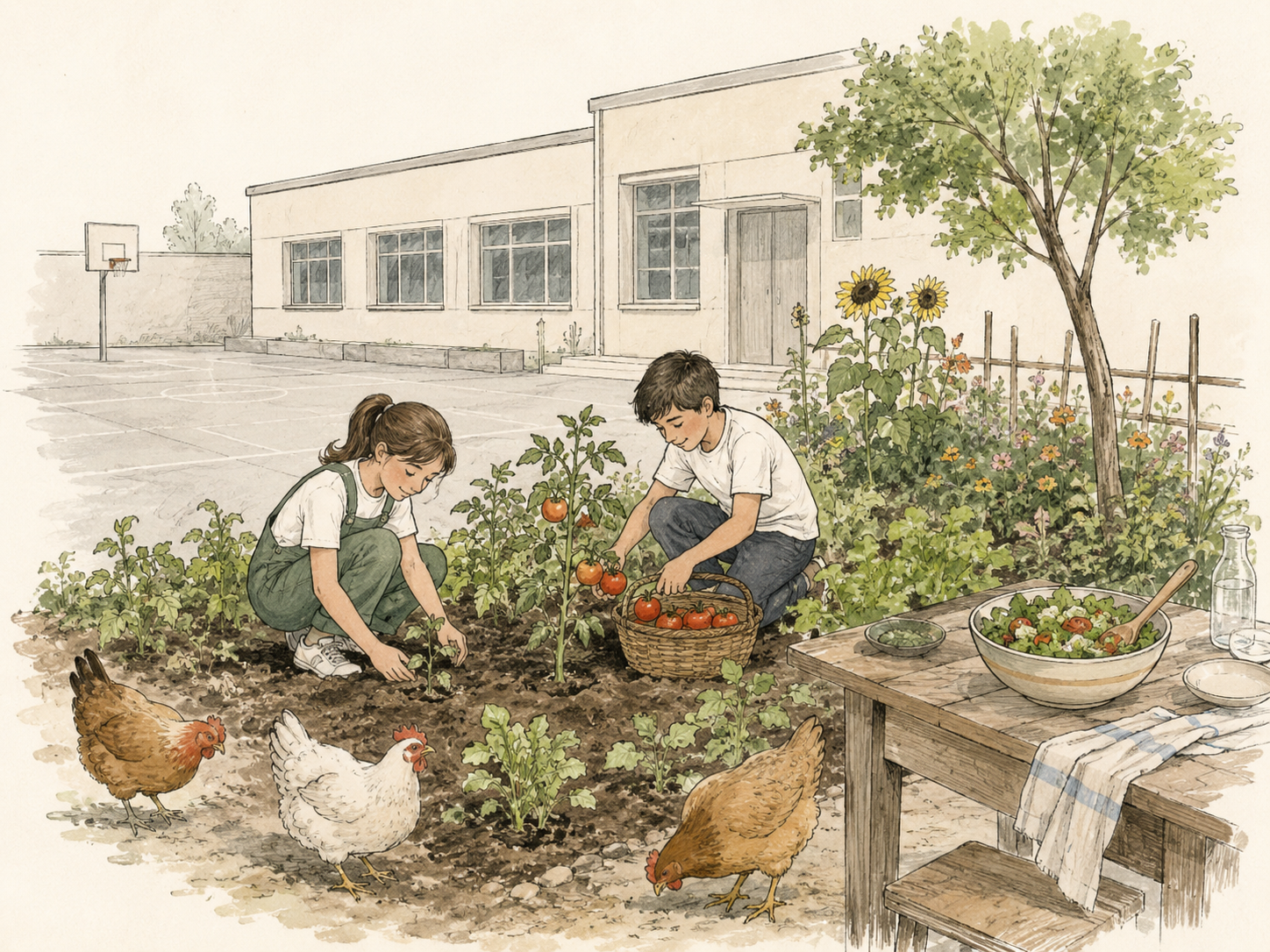
A child should not learn about food only from labels, documentaries, activists, advertisements, or nutrition charts. A child should plant tomatoes, see them grow, understand that they may get sick, learn that they may need treatment, collect them, cut them, make a salad, and eat it. This is not merely agricultural training. It is human education.
Students should be partly farmers and partly cooks. They should learn that food comes from life, time, work, care, failure, weather, soil, insects, animals, and human effort. They should understand that nature is not a clean moral symbol. Nature is living, generous, harsh, dirty, beautiful, and practical.
When education removes children from this reality, it creates personalities that can speak morally about nature without having lived near nature. It creates people who are sensitive, but abstract. Compassionate, but detached. Full of opinions, but poor in experience.
This is why veganism grows so easily in modern urban societies. It is not simply that some people love animals. That is understandable. It is that many people have been educated far away from the real conditions of food production. They know the supermarket, not the farm. They know the image of the animal, not the animal. They know the package, not the process.
Of course, a person raised on a farm can still become vegan. Direct contact with animals may lead some people to reject animal products. But this would be a choice made after contact with reality. It is very different from a moral conclusion formed inside a sterile system, where the child has never seen how food actually comes into existence.
The same error appears in the way society treats smartphones. The state sees that children are absorbed by screens, so it tries prohibition. It says: do not use the phone. But it does not ask the deeper question: why is the phone so attractive?
The phone wins because the real world offered to the child is often empty. Cement instead of soil. Sitting instead of working. Screens instead of animals. Theory instead of practice. Consumption instead of production. When children are not given real things to do, they naturally escape into artificial things.
The state tries to remove smartphones from children’s hands, but it does not put soil, seeds, tools, animals, cooking, music, craft, and responsibility into those hands.
This is a failure of the whole system, not only of the school. Modern society violates the deep nature of the human being. Human beings were not formed by evolution to sit for endless hours under artificial light, surrounded by cement, consuming digital stimulation, eating food made invisible by industry, and forming moral opinions about life without participating in life.
The human being needs contact with the real: soil, plants, animals, family, community, work, risk, hunger, cooking, birth, death, seasons, silence, and responsibility. When these are removed, personality is distorted. Then experts study the distorted personality as if it were normal, while ignoring the unnatural system that produced it.
Veganism, in this sense, is not the main problem. It is a symptom. It is one visible result of an education that has lost contact with life. A society that hides the farm, hides the animal, hides the field, hides the kitchen, and hides labor should not be surprised when its children develop abstract moral ideas about food.
A real education would not be sterile. A real school would have soil, plants, hens, perhaps goats, perhaps even a cow where possible. It would have gardens, kitchens, workshops, and living responsibility. Children would not only learn about nature. They would participate in nature.
They would plant, care, harvest, cook, and eat. They would learn that food is not an object. Food is a relationship between life and life.
That kind of education would not necessarily make every child eat meat, eggs, or milk. But it would make every child more grounded. Their choices would come from experience, not from distance. From participation, not abstraction. From reality, not sterility.
Veganism is a result of bad education because bad education has separated human beings from the living world that feeds them. It has taught them to judge life before teaching them to live within it.
Leave a Reply