Traffic jams should not be accepted as a normal part of modern life.
A temporary delay after an accident, a storm, or a special event is understandable. But daily traffic jams, repeated every morning and every afternoon, are not natural phenomena. They are not acts of God. They are evidence of bad organization.
They show a political failure.
A traffic jam is not only a road problem. It is a time problem, a coordination problem, and finally a governance problem. Too many people are allowed — and often forced — to move at the same time, toward the same areas, using the same roads, usually each person alone inside a private vehicle.
The result is absurd. Millions of people lose hours of their lives sitting inside cars. Energy is wasted without producing movement. People arrive at work already tired and return home already irritated. Families lose time. Businesses lose productivity. Cities become less human.
And still, society treats this as normal.
But why should it be normal?
If a water system failed every morning, politicians would be blamed. If the electricity grid collapsed every afternoon, politicians would be blamed. If schools opened every day with no teachers, politicians would be blamed.
But when the road system collapses every day, we call it “traffic.”
This is too soft. A daily traffic jam is a daily collapse of public coordination.
The usual answer is to build more roads. But more roads are not the real solution. A city can never satisfy unlimited car movement at the same time. Roads are limited public space. They have capacity. When more cars enter than the system can absorb, congestion is inevitable.
The real question is not only how many roads we have. The real question is: why do we allow too many vehicles to enter the road network at the same moment?
Traffic lights already exist to control traffic. But they control traffic too late. They act at junctions, after the car has already entered the system. By then, the congestion may already have been created.
The traffic light must move closer to the real source of the problem.
It must move to the driver’s starting point.
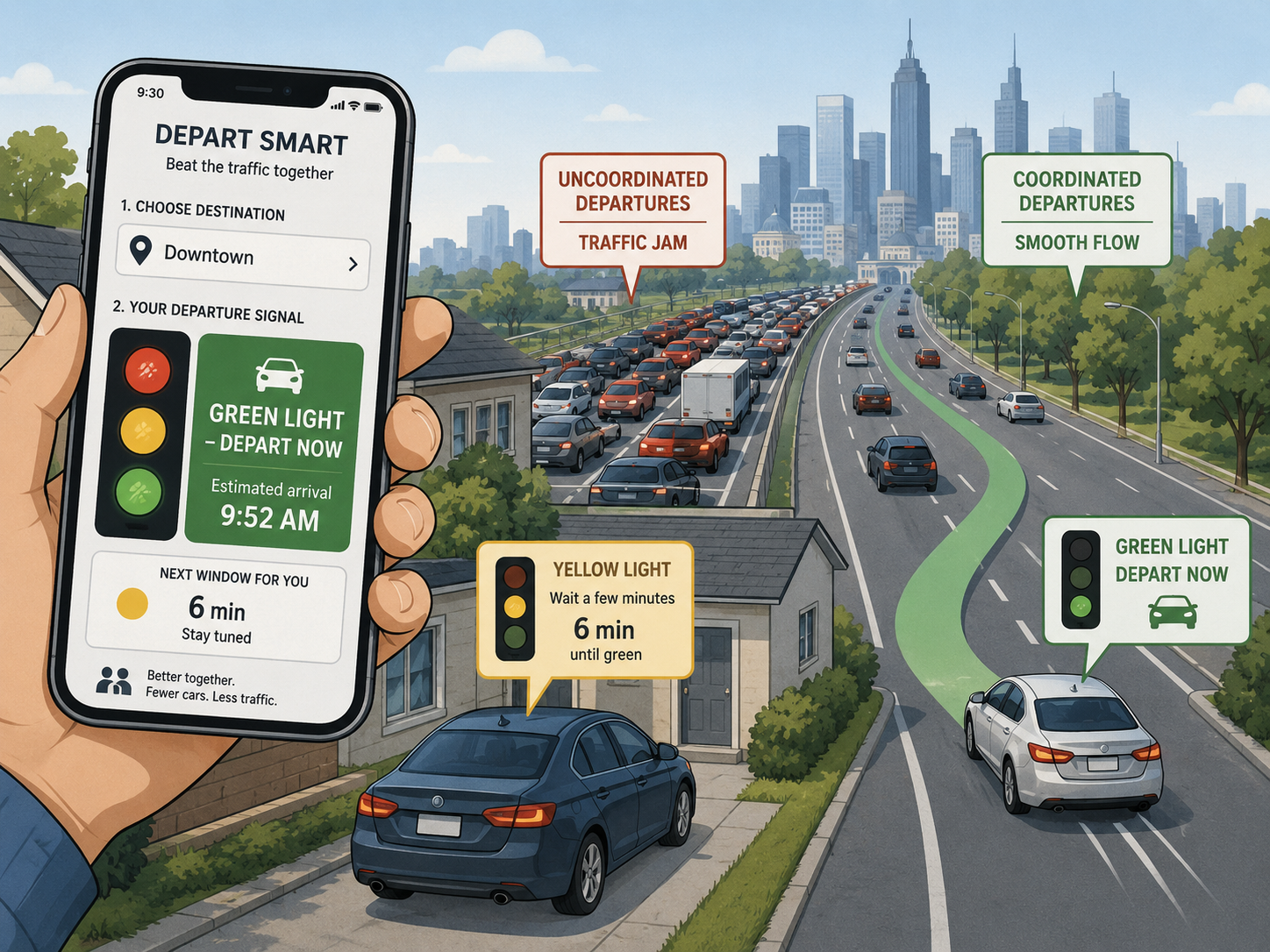
In a modern city, each private car journey could begin with a digital departure signal on the driver’s mobile phone. The driver declares the destination. The starting point is already known through geolocation. The system checks the current and expected traffic along the relevant route, the available road capacity, and the number of other drivers waiting to depart.
Then it gives a signal.
Green: you may start now.
Yellow: prepare; departure will probably be allowed soon.
Red: wait; your departure would worsen congestion.
This is not simply navigation. Navigation tells the driver which route to follow after the trip has begun. This system controls whether the trip should begin now at all.
It is a personal traffic light.
The principle is simple: do not allow cars to enter the road network faster than the road network can absorb them.
Today, the system allows unlimited departures into limited roads. Then, when the roads are overloaded, everyone stops. This is irrational. It is like allowing too many people into a building and then being surprised that nobody can move inside.
A city should manage road access before the jam is created, not only after it appears.
This system would also need prediction. A red signal should not feel like blind punishment. The driver should be told: “Estimated green light in seven minutes.” The phone can warn the driver when the green signal is approaching, so they are ready to depart.
This changes the psychology of waiting. The driver is not trapped in a meaningless delay. The driver is part of a coordinated queue.
Of course, the system must also prevent abuse. If drivers declare false destinations just to get faster permission, the system becomes useless. So it must check whether the driver starts when green is given and whether the vehicle moves toward the declared destination in a plausible time.
This does not require public exposure of private data. It requires controlled use of data by the traffic authority. The destination is not shown to other citizens. It is used only to allocate road capacity.
Some people will object that this violates privacy. But private car use inside a congested city is not purely private. A car uses public road space. It delays others. It pollutes the air. It occupies capacity that belongs to everyone.
So the principle should be clear:
The more public road capacity a person consumes, the more coordination that person must accept.
Walking should not need declaration. Cycling should not need declaration. Public transport should not need personal route declaration. A passenger who wants more privacy can use public transport or a taxi. But a private car travelling through congested public roads is a public-capacity request.
Society has the right to coordinate it.
There should also be exceptions. Emergency vehicles, medical emergencies, police, fire services, and other urgent cases must be treated differently. The purpose is not to freeze society. The purpose is to prevent millions of unnecessary, simultaneous departures from destroying the road network every day.
This system could begin gradually. It could first apply only to busy zones and peak hours. It could begin with incentives rather than penalties: cheaper parking, lower road fees, or priority access for those who obey the departure signal. Later, in heavily congested areas, it could become mandatory for private cars.
Large traffic generators should also be included: companies, schools, universities, shopping centers, public services, and delivery fleets. They should not all create movement at the same hours. A city should manage time as seriously as it manages space.
But time distribution alone is not enough. Staggered work hours may reduce congestion, but they do not guarantee that jams disappear. The stronger solution is real-time departure permission.
A city that can see its traffic in real time should not behave as if it is blind.
Modern technology already allows route prediction, geolocation, traffic analysis, and instant communication with drivers. The missing element is not technology. The missing element is political will.
This is why traffic jams reveal something deeper about politicians.
Either they do not care enough about the lost time, stress, pollution, and daily humiliation of citizens.
Or they do not dare to challenge the idea that everyone should be able to start a private car journey whenever they wish, even if that destroys the mobility of everyone else.
Traffic jams are not proof that cities are too alive. They are proof that cities are badly coordinated.
A serious state would not accept daily congestion as normal. It would treat it as a failure of public management. It would measure road capacity, control departures, protect privacy where possible, create exceptions where necessary, and prevent ordinary jams before they form.
The goal is not to punish drivers. The goal is to respect everyone’s time.
A traffic jam is not freedom. It is the result of millions of uncoordinated freedoms cancelling each other.
Real freedom is movement that actually works.
And if politicians continue to tolerate daily traffic jams, then the conclusion is simple: they either do not care, or they do not dare.
Leave a Reply