Modern democracy suffers from a structural weakness that is visible but rarely confronted directly: the absence of an institutional voice that does not calculate political cost.
In today’s parliamentary system, every elected representative lives under the pressure of re-election. This is natural. A politician who wants to remain in public life must think about voters, parties, polls, media reactions, personal alliances, and future campaigns. But this creates a serious limitation. The political system may know what is necessary, yet avoid it because it is unpopular. It may see the long-term interest of the country, yet sacrifice it for short-term approval.
For this reason, I propose a new form of polity: The Civic Republic.
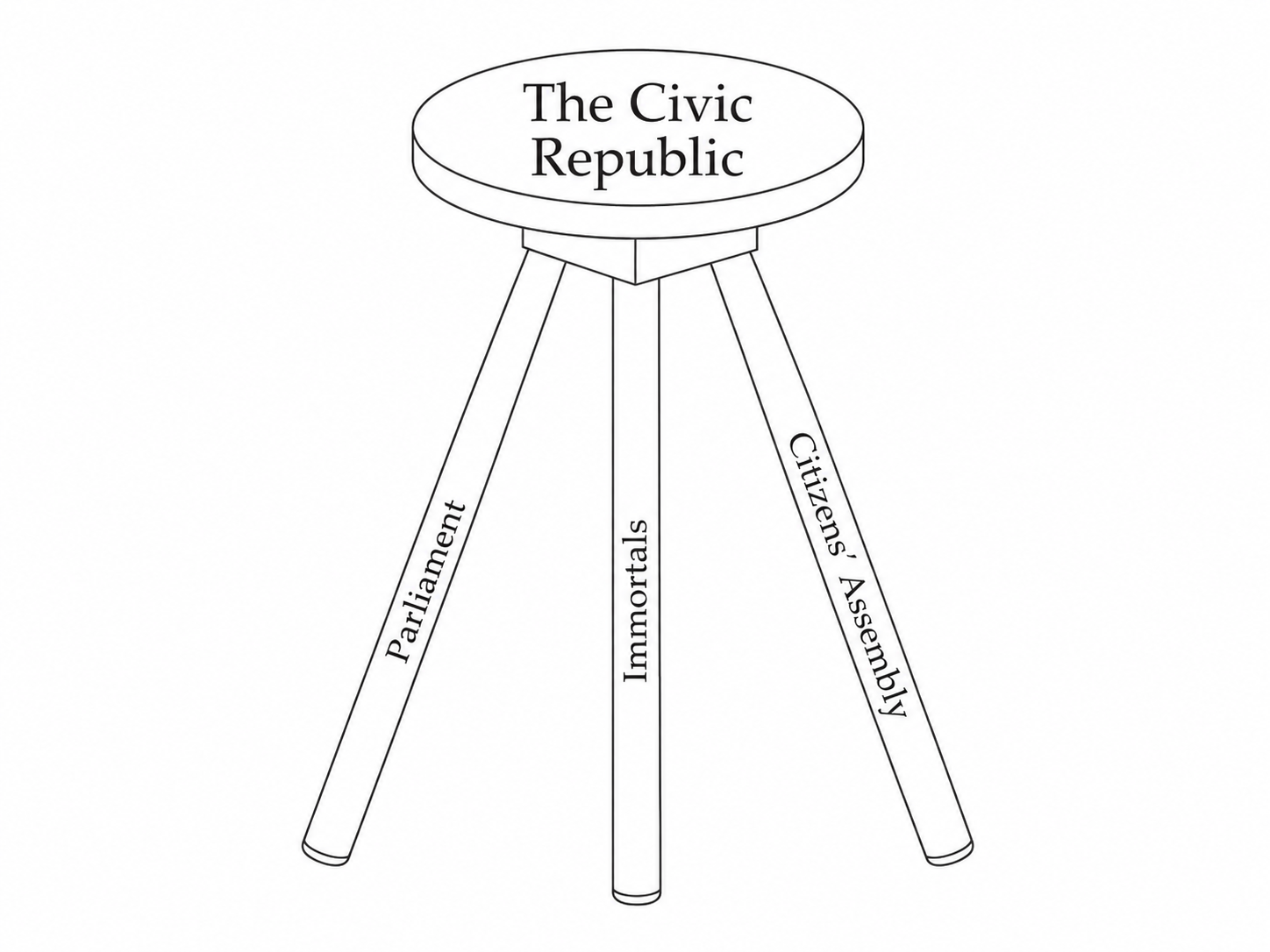
Its purpose is not to abolish parliamentary democracy, but to complete it. The existing Parliament remains, but legislative power is no longer produced by one body alone. Instead, the legislative function is shared among three bodies:
- The Parliament
- The Immortals
- The Citizens’ Assembly
Each body expresses a different democratic necessity. Parliament expresses electoral representation. The Immortals express civic judgment without political cost. The Citizens’ Assembly expresses the living experience of ordinary citizens.
Together, they form a more balanced political system.
The Parliament
The first body is the Parliament as we already know it. In Greece today, this means the elected Parliament of 300 members.
This body continues to exist and continues to play the central role in political life. It represents the organized political will of the people through elections, parties, programs, public debate, and government formation.
However, in the Civic Republic, Parliament no longer holds the entire legislative weight by itself. It holds 50% of the legislative vote.
This means that elected representatives remain the strongest body, but they are no longer alone. No law can be understood only as a product of party power or electoral calculation. The remaining 50% belongs to citizens who do not operate under the same political incentives.
The Immortals
The second body is the Body of the Immortals.
This would be a body of 30 citizens who are not elected. They would be citizens over the age of 50, selected according to three hierarchical criteria:
A. Social conduct
B. Athleticism
C. Mathematical ability
The first criterion, social conduct, is the most important. Athleticism follows. Mathematical ability follows after that. The hierarchy matters because the purpose of the body is not to create a technocracy of clever people, nor an aristocracy of physical strength. The first and dominant requirement is civic character.
The Immortals are called by this name because the institution does not depend on the personal identity of its members. Thirty historical civic names could be assigned to the seats: Pericles, Solon, Cleisthenes, and others. The person serving in the seat changes, but the civic name remains. In this way, the institution emphasizes continuity, responsibility, and symbolic service to the republic.
The Immortals would participate in the legislative process with 25% of the total legislative vote.
Their role is to introduce into the system something that electoral politics cannot easily produce: a voice that has no need to be popular tomorrow. The Immortals do not campaign. They do not seek votes. They do not depend on party approval. Therefore, they can support what they believe is necessary, even when it is uncomfortable.
A democracy needs such a voice. Not because elected politicians are bad, but because electoral pressure is real. A system that depends only on elections risks becoming a system of permanent fear: fear of reactions, fear of cost, fear of losing power. The Immortals are designed to reduce that fear inside the legislative process.
The Citizens’ Assembly
The third body is the Citizens’ Assembly.
This body would consist of 1,000 citizens selected by lot. Their term would last one month. Every month, 1,000 new citizens would be selected.
The Citizens’ Assembly would also hold 25% of the legislative vote.
This body responds to another weakness of modern representative democracy: elected politics often does not hear society directly. It hears what parties choose to present. It hears what organized interests can amplify. It hears what the media decides to highlight. But many real problems remain invisible.
The Citizens’ Assembly brings ordinary citizens directly into the legislative process. Because its members are randomly selected and constantly renewed, it cannot easily become a closed political class. It is not a party. It is not a profession. It is not a career. It is a rotating civic mirror of society.
Through the Citizens’ Assembly, the republic hears real citizens before laws are made. It hears their problems, fears, objections, and common sense. It brings the everyday experience of society into the center of legislation.
A Three-Body Legislative System
In the Civic Republic, legislative power is distributed as follows:
Parliament: 50%
Immortals: 25%
Citizens’ Assembly: 25%
This structure creates a new balance.
Parliament provides democratic continuity through elections.
The Immortals provide judgment without political cost.
The Citizens’ Assembly provides direct social experience through random citizen participation.
A law, therefore, would need support not only from professional politics, but also from citizens outside the electoral mechanism. Half of the legislative weight would belong to people who do not depend on political survival.
This is the central idea of the Civic Republic: the law should not be produced only by those who fear the next election.
Why This Is Still Democracy
Some may object that the Immortals are not elected. But democracy should not be reduced only to elections. Elections are essential, but they are not the only democratic method. Selection by lot also has deep democratic meaning. Civic participation, institutional balance, public responsibility, and protection from concentrated power are also democratic principles.
The Civic Republic does not remove elections. It limits the monopoly of elections over legislation.
The elected Parliament still has the largest share of legislative authority. But it must now cooperate with two other civic bodies. One body represents tested civic character. The other represents ordinary citizens selected by chance.
This creates a democracy that is not only electoral, but also civic.
The Aim of the Civic Republic
The aim of this system is not to weaken the people’s will. It is to protect it from distortion.
The people’s will is not always identical to party strategy. Society’s real needs are not always identical to campaign promises. Long-term justice is not always identical to short-term popularity.
The Civic Republic tries to solve this by giving institutional power to three different forms of citizenship:
The citizen as voter.
The citizen as responsible elder.
The citizen as ordinary member of society.
The Parliament, the Immortals, and the Citizens’ Assembly together create a more complete expression of the republic.
Conclusion
Every political system has its blind spots. The blind spot of modern parliamentary democracy is that it asks elected politicians to act beyond political cost, while forcing them to live under political cost every day.
The Civic Republic accepts this contradiction and tries to correct it institutionally.
It does not expect politicians to become saints. It does not expect parties to ignore power. It does not expect society to be heard automatically. Instead, it designs a system where different kinds of civic voice are structurally present in the making of laws.
The Parliament brings electoral legitimacy.
The Immortals bring courage without electoral fear.
The Citizens’ Assembly brings the direct reality of society.
This is the proposal of the Civic Republic: a democracy where legislation is not only the work of political power, but the shared work of the republic itself.
Leave a Reply