In a previous article, I argued that the fair tax is not a tax on income, property, consumption, inheritance, profit, or any other visible monetary result.
The fair tax is the product that corresponds to equal time and equal risk.
This principle matters because income alone is a very poor measure of fairness. Two people may earn the same money, but one may need four hours to produce it while the other needs sixteen. Their income is equal, but their productive power is not equal. To tax them equally because the final monetary result is the same is not justice. It is blindness.
Risk makes the problem even deeper. Some income is produced under certainty, while some income is produced after uncertainty, danger, debt, loss, and possible failure. If the state taxes the profitable result without sharing the previous risk or the possible loss, then the state becomes an unfair partner. It arrives after the battle and demands a share of the victory.
So the state cannot honestly calculate the perfectly fair tax from declared income. It does not really know the time, risk, ability, opportunity, fear, luck, social power, or sacrifice behind a monetary result.
This leads to a necessary reversal.
The citizen does not originally owe money.
The citizen owes civic time.
Money is not the original debt. Money is only the price of keeping that civic time private.
This article examines some implications of that idea.
From fair tax to civic time
If the fair obligation is based on equal time and equal risk, then the practical institution should begin from time, not money.
Every citizen over a certain age should owe two full days per calendar week to public service and public production.
These are not two days out of the five-day working week. They are two days out of the seven-day week. The obligation concerns life-time, not merely labor-market time.
The assigned days may fall on a Monday, a Saturday, a Sunday, or any other day. They should be selected randomly by a public algorithm and created one year in advance, so that citizens can plan their lives.
This matters. The state should not surprise the citizen every week. A citizen should know his civic-service calendar early enough to organize work, family, holidays, study, business, travel, and rest.
The citizen may serve the assigned day. Or, if he wants to keep that specific day private, he may buy it back.
The buy-back price should increase progressively. The first bought day may be relatively cheap. The second should be more expensive. The third even more expensive, and so on.
This does not mean that the state classifies citizens as rich or poor. A state should not care whether someone is rich or poor. It should not build the system around moral categories of class.
The rule is neutral:
Serve the assigned civic day, or buy it back at the official increasing price.
If someone buys many days, he will need much more money. The state does not need to ask who he is, where his money came from, or whether he is rich. The act itself reveals that he values private time enough to pay the price.
Public service as the original tax
Modern people usually think of taxation as money first. The citizen pays money, and the state hires people to perform public tasks.
But this separates the citizen from the common good. The citizen becomes a payer, not a participant. The common good becomes something outsourced to professionals and contractors.
The fair-tax principle reverses this.
The original obligation is public service. Money is only a substitute.
The state does not begin by saying:
“You owe me money.”
It says:
“You owe civic time to the common good.”
If the citizen does not want to give that time on a specific assigned day, he may buy it back. But the debt is not monetary in origin. The debt is civic.
This makes taxation more honest. Every tax already takes time indirectly. If a person works eight hours and pays 25% tax, then two hours of his labor have effectively gone to the state. The current system hides this behind money.
The proposed system makes it visible.
The common good requires time. The citizen may give the time directly, or pay to keep it private.
The end of income hiding as a tax problem
A major implication is that people would have much less reason to hide income for tax purposes.
In the current system, income is the tax base. So people hide income, transform income, delay income, move income, disguise income, and fight over what should count as income. The state then creates a huge machinery of declarations, audits, penalties, exemptions, deductions, investigations, and suspicion.
This becomes a permanent war between the citizen and the tax authority.
But civic time is visible.
Either the citizen appears for the assigned public-service day, or he buys it back.
The state does not need to know whether money came from salary, rent, dividends, business, stocks, inheritance, family wealth, speculation, reputation, hidden influence, or luck.
The question is much simpler:
Did the citizen serve, or did he buy back the day?
This does not mean that illegal money disappears. People may still hide money for criminal or private reasons. But the central tax incentive to hide income becomes much weaker, because income is no longer the main tax base.
The tax base becomes visible civic time.
A new economic instrument
The implications go far beyond taxation.
Modern governments often avoid direct production. They prefer regulation, subsidies, public contracts, taxation, interest rates, monetary policy, and public spending. But this creates a dangerous weakness.
The state may have money, laws, police, courts, and authority, but not productive hands.
This may be tolerable in a simple and stable environment. But we do not live in such an environment. We live in a complex, unstable, almost chaotic environment. Supply chains break. Wars happen. Pandemics happen. Energy shocks happen. Oligopolies raise prices. Essential goods become expensive. Skills disappear. Whole sectors become fragile.
In such a world, it is risky for the state to avoid production almost completely.
A state that controls only money controls shadows. A state that can organize production controls reality.
This is why civic time should be understood as a new economic instrument.
If prices rise because of shortages, bottlenecks, oligopolies, or aggressive pricing in basic goods, the state should not only change interest rates or money supply. These are indirect tools. They do not produce food, medicine, repairs, clothes, houses, nursing, logistics, or energy.
A state with organized civic time can respond differently.
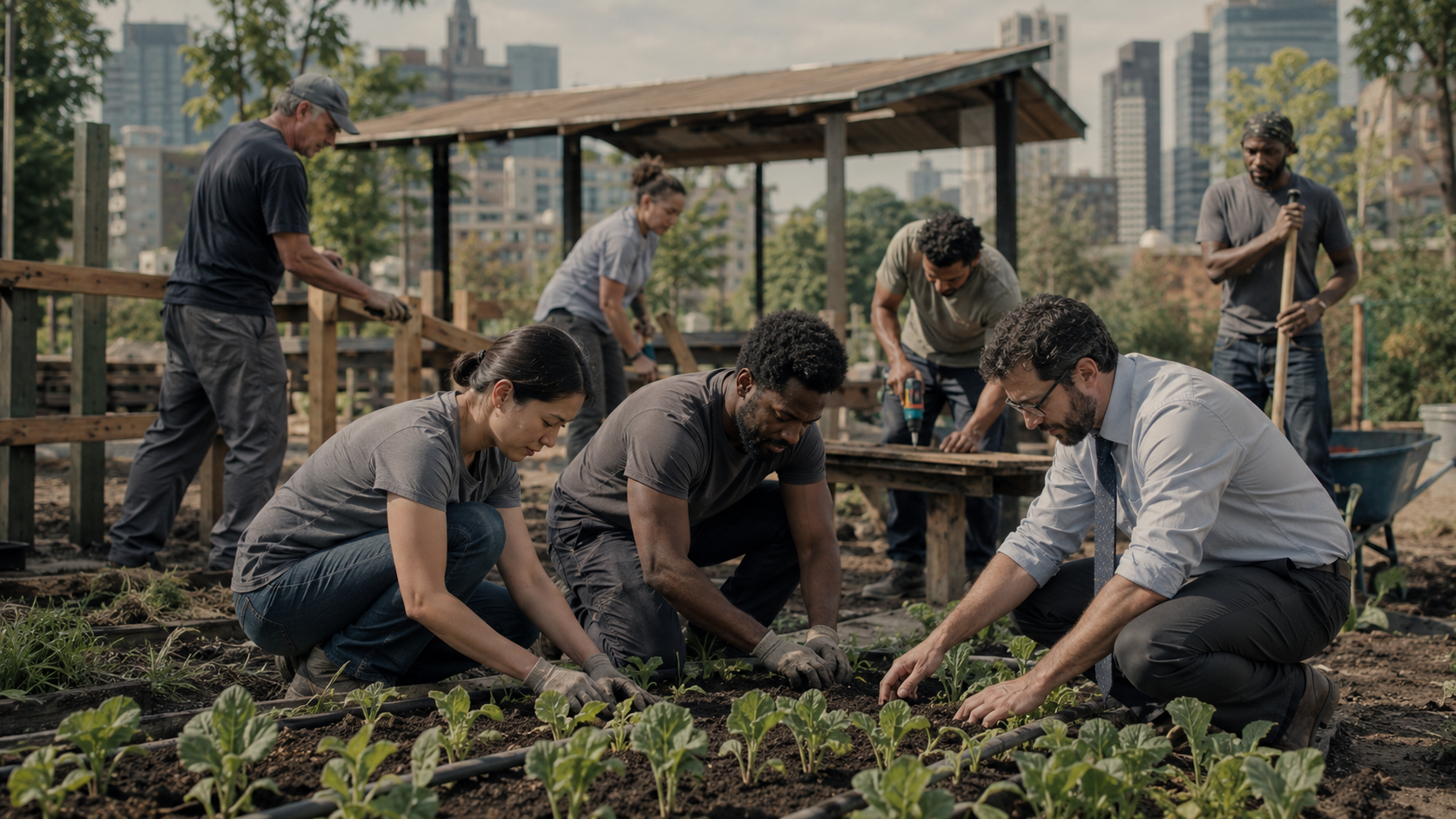
It can direct public-service capacity toward agriculture, food distribution, basic manufacturing, public maintenance, construction support, elderly care, health support, logistics, disaster response, environmental work, and other essential sectors.
This gives the state a real anti-inflation and anti-oligopoly instrument.
If private producers of basic goods exploit society, the state can produce or support production directly. Even if it is less efficient in ordinary accounting terms, it can secure a basic survival level.
And perhaps the sacrifice is not even real in the long run.
A society that builds skills, flexibility, emergency capacity, productive knowledge, and cross-sector experience may finally become more productive overall.
The time budget of the state
If such a system existed, economic theory would have to change.
In standard models, T usually means taxes, meaning monetary taxes. But in a civic-time society, taxation is not only monetary. The primary obligation is time.
So fiscal policy should not be understood only as government spending and money taxation. It should also include the institutional allocation of civic time.
The state would have two budgets:
a money budget,
and a time budget.
The time budget would show how many civic days society can direct toward public purposes. It would show which sectors need public-service capacity, which regions need support, which goods are strategically necessary, and which public projects require human contribution.
In that sense, t should not enter theory only as a time index in dynamic models. Time should also enter as a fiscal policy instrument.
The state can impose, schedule, release, redirect, or allow the buy-back of civic time. This affects production, private time, public output, labor allocation, inflation pressure, resilience, and social structure.
This is not a small technical correction. It changes the meaning of fiscal policy.
Fiscal policy is not only the movement of money.
It is also the organization of society’s time.
Flexibility must be built
Economists often speak about labor as if it were a homogeneous substance. They write L in a model and think they have described human work.
But labor is not a letter.
A plumber is not instantly an agricultural worker. An accountant is not instantly a nurse assistant. A programmer is not instantly a textile worker. A teacher is not instantly a construction assistant.
So when economists speak about labor flexibility, they often assume what society has never built.
Flexibility is not a hypothesis. It is an institution.
Civic-time duty would expose citizens to many forms of work outside their original profession. An accountant may learn agriculture. Later in life, if accountancy faces unemployment, he may have another path. Or he may combine accounting knowledge with agriculture: farm management, cooperative accounting, cost control, logistics, export organization, public procurement, or rural business planning.
The same applies everywhere. A lawyer may learn food distribution. A journalist may learn public maintenance. A teacher may learn elderly care. A programmer may learn clothing production. A shop worker may learn energy support.
This creates a society where people are not trapped forever inside one narrow professional identity.
It also gives the economy genuine flexibility. Not flexibility as a slogan. Not flexibility as a mathematical assumption. Real flexibility, built through experience.
Respect for other people’s work
There is also a moral dimension.
People often speak about professions they have never experienced. They speak about farmers without ever touching soil. They speak about nurses without ever helping the sick. They speak about builders without ever carrying materials. They speak about manufacturing without ever standing near repetitive production.
This creates arrogance and ignorance.
Civic duty forces society to experience itself.
An accountant who has worked in agriculture will never again speak about farmers as if food appears magically. A journalist who has assisted in nursing will write differently about hospitals. A politician who has helped in public maintenance will understand infrastructure differently. A professor who has worked in manufacturing will understand production differently.
People do not only learn skills. They learn what other people’s work costs.
This may be one of the greatest social effects of the institution. Civic time would create humility. It would turn social classes and professions from abstractions into lived knowledge.
A temporary reversal of hierarchy
The institution would also affect hierarchy.
People with social power in ordinary life may find themselves under the direction of others during civic duty. A businessman, journalist, professor, politician, lawyer, manager, or famous person may have to follow the instructions of a farmer, nurse, technician, builder, mechanic, cook, or logistics supervisor.
This is healthy.
In ordinary society, hierarchy often follows money, education, visibility, office, fame, or connections. But during civic duty, hierarchy should follow functional competence.
The one who knows the work leads the work.
So a socially powerful person may temporarily obey someone socially invisible but practically necessary. This is not humiliation. It is education.
It teaches that society is not held together only by titles, capital, speeches, and theories. It is held together by people who know how to plant, repair, clean, carry, manufacture, care, cook, maintain, and build.
For a few days each week, prestige would be corrected by usefulness.
Reaching those who escape the income-tax system
The civic-time system would also reach people who often escape income taxation.
Unknown thieves, drug dealers, fraudsters, and other socially harmful people may declare little or no income. The state may not see their real economic life. But under civic-time duty, they still face the same visible choice as everyone else:
Serve the assigned day, or buy it back.
This matters because a person who has never worked beneficially for society receives an opportunity to do so.
Some people may have lived from crime, exploitation, fraud, parasitic dependence, or total disconnection from productive life. Civic duty says to them:
You are still a citizen. You still owe civic time. Come and produce something useful.
This does not mean we should be naive. Dangerous people must not be placed in sensitive tasks. Work with children, vulnerable elderly people, medical supplies, security systems, money, or confidential information must require screening, supervision, and safeguards.
But the principle remains powerful.
The system does not merely punish or extract. It may transform. It may give some citizens their first real experience of socially useful work.
Not everyone will change. But some may.
A person who plants, repairs, cleans, distributes, manufactures, or builds may discover a different relationship with society.
The army analogy
Many countries already accept the principle that the citizen may owe time directly to the common good.
Military service is exactly that. It is not an income tax. It is not a property tax. It is not a consumption tax. It is a time obligation.
If the state may require citizens to give time for national defense, why should it be unthinkable to require civic time for social defense?
Military service protects society against external enemies. Civic production service would protect society against internal fragility: shortages, oligopolies, inflation in basic goods, loss of skills, unemployment, social separation, and dependence on private suppliers for survival.
The army has soldiers.
This institution could have civic producers.
The point is not militarization. The point is organized contribution. A society should not rely only on money and markets for its basic survival. It should have a permanent civic capacity to produce, repair, care, and respond.
The deeper meaning
The fair-tax article established the moral basis:
Tax only the product that corresponds to equal time and equal risk.
But because equal risk cannot truly be measured, and because income does not reveal true power, the state cannot calculate the fair tax directly.
So the fair tax must be applied indirectly.
Every citizen receives the same civic-time obligation. Whoever wants to keep assigned time private may buy it back at an increasing price.
That is the tax mechanism.
But the implications are much larger.
This institution would revise the meaning of taxation. It would revise the meaning of labor. It would revise fiscal policy. It would revise the relationship between state and production. It would revise the connection between citizenship and service.
It would reduce the importance of hidden income.
It would create direct public productive capacity.
It would give the state a real anti-inflation and anti-oligopoly instrument.
It would build labor flexibility instead of assuming it.
It would expose citizens to other professions.
It would teach respect for work.
It would temporarily reverse social hierarchy in favor of practical competence.
It would offer socially disconnected people a path into useful contribution.
And it would make society more resilient in a complex and chaotic world.
A modern state should not only collect money from society. It should be able to organize the time of society when the common good requires it.
Because money alone cannot plant, nurse, repair, build, manufacture, harvest, transport, or care.
Only people can.
And a society that has organized civic time has something stronger than taxation.
It has a living reserve of productive citizenship.
Leave a Reply