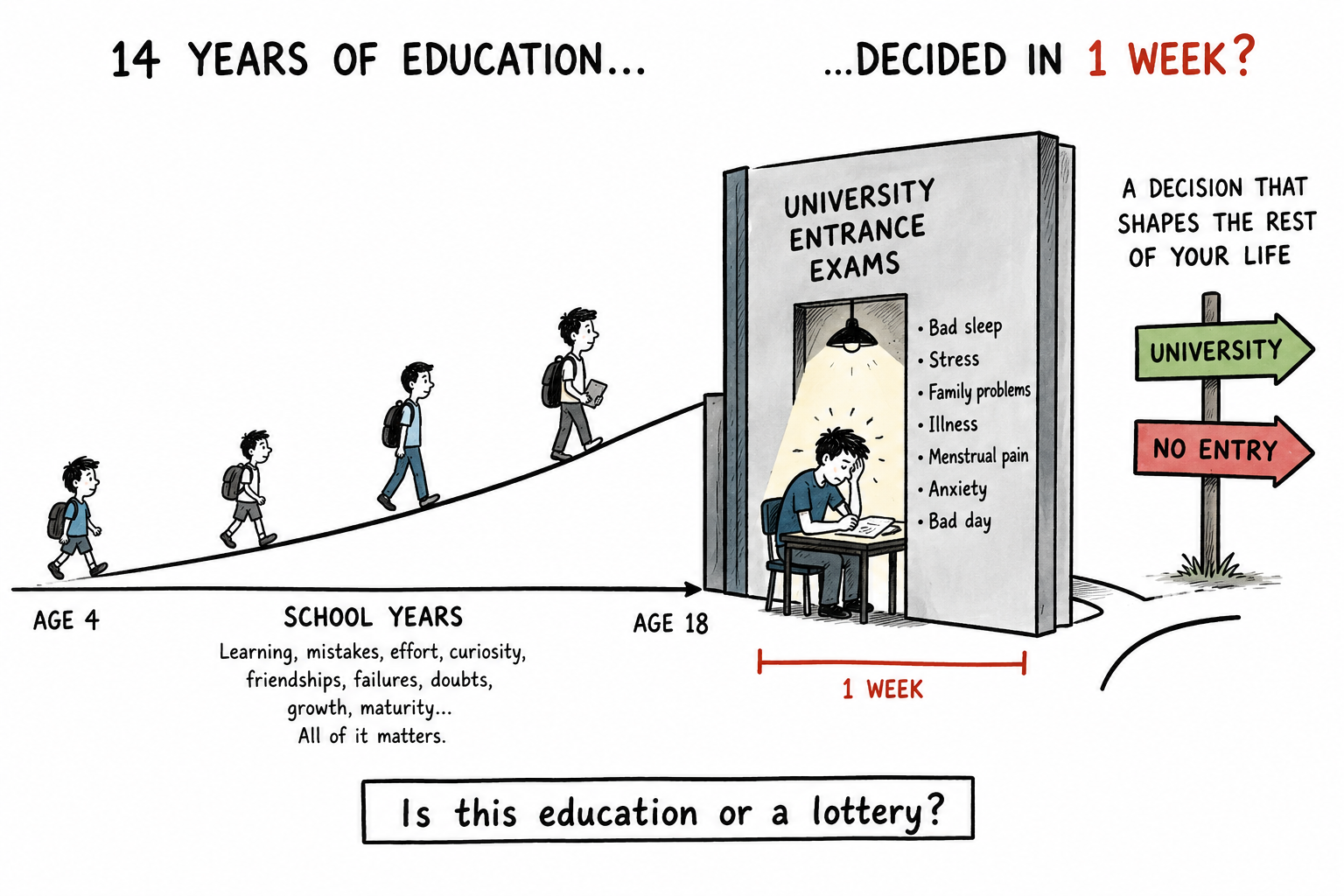
A society takes a child at the age of four, keeps that child inside an educational system until the age of eighteen, and then, at the end, behaves as if it knows almost nothing about the student.
After fourteen years of schooling, it asks the student to sit for a few examinations, usually within one narrow period, and from this compressed moment it decides university entrance. This is not wisdom. It is not serious evaluation. It is administrative convenience disguised as meritocracy.
Of course, exams may be necessary. A society needs some way to decide who enters which university department, especially when places are limited. But the question is not whether there should be evaluation. The question is whether it is rational, fair, or even human to decide so much of a young person’s future through a few exam papers written in one week.
A student may have worked seriously for years. They may have understood deeply, improved slowly, developed discipline, curiosity, judgment, and maturity. But if they sleep badly the night before the exam, if there is tension in their family, if they are ill, if they are psychologically exhausted, if their environment is unstable, the system does not care. The system says: perform now.
For girls, there is another obvious issue that is almost never discussed seriously: the menstrual cycle. Pain, fatigue, poor sleep, discomfort, or emotional pressure may affect concentration during those critical days. This does not mean that girls are less capable. It means that students are human beings with bodies, not machines that produce identical performance on command.
So the examination system does not only measure knowledge. It measures timing, sleep, stress tolerance, family conditions, physical condition, and luck. A student is not judged only by what they know, but by whether their body and life happen to cooperate during a tiny window of time.
There is also another truth: the system does not trust teachers. And, in many cases, it is right not to trust them as final examiners. Teachers are not always objective, not necessarily because they are dishonest, but because they are human. They know the students personally. They may be influenced by sympathy, behavior, parents, school culture, pressure, habits, or their own grading standards.
One teacher’s 18 may be another teacher’s 14. Every teacher may have a different system of judgment. This creates injustice. But you do not solve one injustice by creating another.
If teachers are not reliable as final judges, then the answer cannot be to ignore twelve or fourteen years of education and decide everything in a few final exams. A teacher should teach. A teacher should guide, correct, observe, and help the student grow. But the teacher should not be the final examiner who determines the student’s future. Teaching and final selection are different roles.
Still, even this is not the deepest problem.
The deeper problem is the blind belief that grades from different subjects can simply be added together. A student gets 14 in mathematics, 18 in physics, 14 in chemistry, and 18 in language. Then the system adds these numbers, perhaps with weights, and produces a final value. But what exactly has been added?
Can mathematical ability, physical reasoning, chemical knowledge, and language expression be reduced to one common substance? Are these numbers really the same kind of thing? Even inside mathematics, can geometry and number theory be averaged as if they are identical abilities? This is like saying: I have two apples in one hand and four pens in the other, so on average I have three what per hand?
Numbers create the illusion of precision. But not every number represents something that can be meaningfully added. A grade is not a kilo, not a meter, not a euro. It is a judgment. And when different judgments about different human abilities are mixed into one final score, the result may look scientific while being philosophically absurd.
This is why the system is not merely harsh. It is intellectually weak.
It does not know how to evaluate students over time.
It does not trust teachers.
It does not separate teaching from final examination.
It does not respect the biological and psychological reality of students.
It pretends that different abilities can be added into a single number.
And then it calls this justice.
I will not present here a solution, because my objections are more fundamental. Before discussing a better mechanism, we must first admit that the current logic is broken. We must stop pretending that a one-week examination period can summarize a human being’s educational journey.
And at every possible turn, politicians again fail. They inherit a bad system, defend it as objective, fear changing it, and leave young people to carry the burden of their cowardice. They do not solve the problem. They preserve it. And then they call it education.
Leave a Reply