Author: Dimitris

  • Natural Wealth Belongs to Everyone

    Natural Wealth Belongs to Everyone

    Natural Wealth Belongs to Everyone

    Poverty inside a country rich in land, water, minerals, forests, seas and natural beauty is not only an economic failure. It is a moral contradiction.

    No individual created the earth. No individual created the rivers, the mountains, the fertile land, the minerals under the ground, the forests, the coastline, the fish of the sea, or the natural position of a country on the map. These things existed before any private owner, before any company, before any state budget, before any political party.

    And yet, in modern societies, the economic value of natural resources is often captured unequally. Some people control land and resources of great value. Others are born with nothing. They are then told that survival depends only on wages, charity, welfare programs, or the goodwill of the state.

    This is not enough.

    I propose a moral principle: the Equal Distribution of Natural Resource Revenue.

    The idea is simple. Private ownership does not need to disappear. A person may own land, use land, cultivate land, build on land, or rent land. But when someone has exclusive control over a natural resource, they should compensate the rest of society for the natural value they exclude others from using.

    This compensation would form Natural Resource Revenue. That revenue should not disappear into the general state budget. It should be returned equally to all citizens as a Natural Wealth Dividend.

    This dividend would function as a safety net, even as a kind of minimum income. But its moral basis would be completely different from welfare. Welfare says: society helps those who are poor. The Natural Wealth Dividend says: every citizen receives their equal share of the natural wealth that belongs morally to all.

    That distinction is important. A person receiving this dividend is not begging. He is not receiving charity. He is receiving his share.

    This principle is fair because it does not punish work. It does not punish talent. It does not punish production. It does not punish someone for building a house, starting a business, cultivating land, or creating value through effort.

    It asks a different question:

    If a natural resource was not created by any individual, why should its value belong exclusively to the person who controls it?

    The practical effects could be very powerful.

    First, it would reduce poverty directly. A citizen with no land and no natural-resource ownership would still receive a share of the country’s natural wealth. A family would receive multiple shares. This would create a floor under human life. It would not make everyone rich, but it could prevent the fear of hunger, collapse, and total exclusion.

    Second, it would reduce the humiliation of dependency. Many safety-net systems treat the poor as cases to be examined, approved, rejected, controlled, or suspected. A universal Natural Wealth Dividend would not need to ask whether someone is worthy. It would be a right of citizenship.

    Third, it would discourage the underuse of resources. Today, someone can own valuable land and do nothing with it. They can wait while roads, cities, tourism, public infrastructure, and social development increase its value. They can store wealth passively while others struggle for survival.

    With an annual charge on natural-resource value, idle ownership becomes less attractive. The owner must either use the land productively, rent it, sell it to someone who will use it, or pay society for the privilege of excluding everyone else. This does not mean destroying nature. Forests, protected areas, ecological reserves and public spaces must remain protected. The target is not nature; the target is private idleness and speculative hoarding.

    Fourth, it would make private property more responsible. The principle does not abolish property. It civilizes it. It says: you may privately use what nature gave, but you cannot forget that others have been excluded from it.

    Fifth, it would reduce inherited privilege. Some people are born into ownership of land and valuable natural assets. Others are born with nothing. The Natural Wealth Dividend would not confiscate inheritance, but it would prevent inherited control over natural wealth from becoming an unlimited advantage against those born outside ownership.

    Sixth, it would strengthen real freedom. A person who has no minimum income is not truly free. He may be legally free, but in practice he can be forced by necessity to accept humiliation, exploitation, or destructive work. A Natural Wealth Dividend gives people breathing space. It gives them the minimum confidence needed to say no.

    Seventh, it may even reduce one of the deep causes of war. Many wars, directly or indirectly, are connected to the control of land, oil, gas, water, minerals, ports, fertile regions, sea routes, and strategic territory. If humanity accepted that natural wealth must be shared rather than captured, then the incentive to conquer resources would lose much of its force.

    War would not disappear completely. Human conflict has many causes: power, fear, nationalism, religion, revenge, ideology, madness. But one of the oldest material causes of war — the violent struggle for exclusive control of natural wealth — would be weakened.

    The principle also changes the meaning of the state. The state should not merely be a tax collector. It should be the guardian of common natural wealth. Its duty should be to ensure that no citizen is excluded from the value of the earth under his feet, the water around him, and the natural resources of the country to which he belongs.

    Of course, implementation matters. The system would need fair valuation. It should charge the natural value of land and resources, not the value created by human effort. A person should not be punished for improving land, building, planting, producing, or working. The charge should fall mainly on the natural and location value that no individual created alone.

    The collected revenue must also be returned transparently and equally. If the money is absorbed by bureaucracy, corruption, political favors, or hidden state spending, the moral principle is destroyed. The dividend must be visible. Every citizen must know: this is my share of the country’s natural wealth.

    The deeper aim is not only economic. It is psychological and social.

    When people feel abandoned, they become afraid. When they are afraid, they become passive, angry, extreme, or desperate. But when they know that society has placed a real floor under their survival, confidence can return. And confidence is not a small thing. It can change the behavior of a whole country.

    Even those who would pay more under such a system should think carefully. A society collapsing into poverty and fear is dangerous for everyone, including the wealthy. People who know how to create wealth will be able to create even more in a society that has regained stability, trust and self-confidence.

    Natural wealth belongs to everyone. Private use may be allowed, but exclusive control must carry a social obligation.

    The Equal Distribution of Natural Resource Revenue is not envy. It is not charity. It is not hostility toward ownership. It is the correction of a basic injustice: that some people can privately capture the value of what no private person created, while others are left with nothing.

    A civilized society should begin from this principle:

    Before we divide people into rich and poor, employers and workers, owners and tenants, taxpayers and welfare recipients, we must first recognize the common inheritance beneath all economic life.

    The earth was not made by the landlord.
    The water was not made by the investor.
    The minerals were not made by the company.
    The sea was not made by the state.

    Natural wealth belongs to everyone.
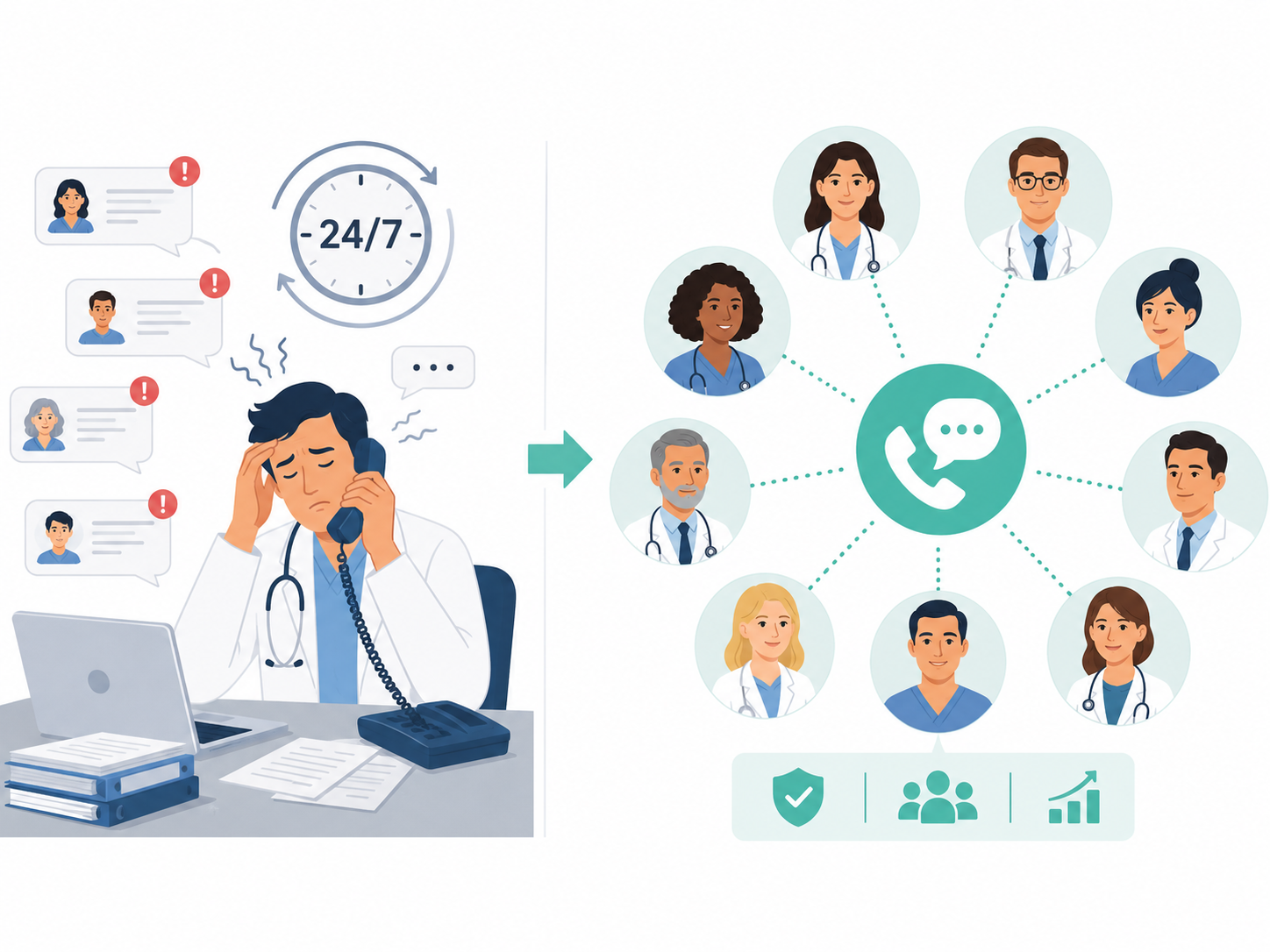
  • Healthcare Should Not Depend on One Exhausted Doctor’s Phone

    Healthcare Should Not Depend on One Exhausted Doctor’s Phone

    A strange contradiction exists in modern healthcare.

    Doctors officially work specific hours. They may work eight hours in the morning, or they may work in shifts. On paper, their working day has a beginning and an end. But in reality, many doctors remain connected to their patients through private phone calls and messages every day of the year, at every hour of the day and night.

    This is not a real healthcare system. It is an informal emergency system built on the personal sacrifice of doctors.

    Patients are not satisfied either. They do not know when they should call. They do not know whether the doctor will answer. They do not know whether they are disturbing someone who is sleeping, working, driving, operating, or trying to rest. So the patient feels insecure, and the doctor feels trapped.

    Healthcare should not depend on one exhausted doctor’s phone.

    An emergency can happen at any time. Illness does not respect office hours. Fear does not wait for Monday morning. Pain does not wait for a doctor to finish dinner. It is crazy that a person in medical anxiety may have to wait even minutes before being received by the healthcare system.

    This does not mean that every case can be solved instantly. Some cases need examination, tests, an ambulance, a hospital, or a specialist. But the first response must be immediate. The patient must know that the system has received the case and that someone officially responsible is acting.

    For this reason, we should move from the model of one doctor per patient to the model of one stable medical team per patient.

    My proposal is simple in principle: every patient should belong to a stable team of eight doctors, not to one isolated doctor. The patient should not experience this as eight different doctors. The patient should experience it as one medical identity: one team, one phone number, one message point, one shared patient record, one responsibility.

    The active doctor at each moment would receive the calls and messages. The patient would not need to know which doctor is working. The patient would not collect eight phone numbers. The patient would not repeat the same story again and again. The team would share the medical record, the message history, the notes, the decisions, and the emergencies.

    The structure could work like this.

    Four doctors would permanently cover Monday to Friday in fixed six-hour periods:

    2:00–8:00
    8:00–14:00
    14:00–20:00
    20:00–2:00

    The other four doctors would cover Saturdays, Sundays, all holidays, and the 60 annual leave days of the first four doctors, again in the same six-hour pattern.

    This means that every doctor works six hours per day. That is not a luxury in healthcare. It is a necessity. Doctors need a clear mind. They must remember patients, judge symptoms, understand risk, and make decisions that may affect life and death. A tired doctor is not only an unhappy worker. A tired doctor is a danger created by bad organization.

    The fixed time periods are also important. The doctor who works from 2:00 to 8:00 should always work that period. The doctor who works from 8:00 to 14:00 should always work that period. The system should not constantly rotate doctors from morning to afternoon to night. That destroys the body’s rhythm.

    In this proposal, each doctor changes their biological rhythm only once. The night doctor adapts to night work. The morning doctor keeps a morning rhythm. The afternoon and evening doctors keep their own rhythm. This protects the health of doctors, their sleep, their family life, and their mental stability.

    Payment should also recognize that not all hours have the same human cost.

    A possible payment structure could be:

    2:00–8:00: $12,000
    8:00–14:00: $6,000
    14:00–20:00: $9,000
    20:00–2:00: $9,000

    The morning period is the most natural working period for most people. The deep night period is the hardest. The afternoon and evening periods damage social and family life more than the morning period. A serious healthcare system should not pretend that all hours are equal. It should pay doctors according to the real biological and social burden of the hours they cover.

    New technologies make this model far more realistic than it would have been in the past. Shared medical records, structured messages, internal notes, alerts, summaries, and artificial intelligence tools can help the active doctor understand the patient quickly. The system should not depend only on personal memory. It should combine stable human teams with strong technological continuity.

    The greatest objection is obvious: this model needs far more resources.

    But this is exactly the question society must answer. What are we willing to sacrifice in order to have real healthcare?

    If we want continuous medical care, then we must move people, money, and attention from less important activities into health. We may need less consumption and more care. We may need fewer useless administrative layers and more doctors, nurses, assistants, and caregivers. We may need fewer resources spent on luxury, advertising, bureaucracy, and low-value services, and more resources spent on direct human protection.

    A society cannot say that health is its first priority and then organize healthcare as if doctors were private 24-hour hotlines.

    A civilized society should not leave patients alone in fear, and it should not leave doctors alone under permanent pressure.

    The goal is not to make doctors work more. The goal is to organize care better. The goal is to protect patients without destroying doctors. The goal is to replace informal sacrifice with official responsibility.

    One patient. One stable medical team. One contact point. Continuous care.

    That is the direction healthcare should take.

  • No Public Trust Without Public Responsibility: Every Website Should Say Who Is Behind It

    No Public Trust Without Public Responsibility: Every Website Should Say Who Is Behind It

    Many times, we visit websites and we cannot understand who is behind them.

    There are no legal terms. There is no clear country of origin. There is no responsible person, no company name, no real address, sometimes not even proper contact details. A site may publish claims, sell products, collect personal data, influence opinions, ask for money, or present itself as an authority — while hiding completely behind a domain name.

    This is not a small technical problem. It is a problem of public responsibility.

    The internet has become one of the main spaces where people receive information, buy services, form opinions, and make decisions. But in the physical world, responsibility usually has a name and an address. A shop has an owner. A newspaper has a publisher. A company has a legal base. A doctor, lawyer, consultant, or institution cannot simply appear from nowhere and demand trust.

    Why should websites be different?

    There should be a global standard requiring every serious website to have a clear and easy-to-find identity page. This page should not be hidden in small letters or written in confusing legal language. It should be simple, direct, and standardised.

    It should say who owns or controls the site, the country under whose laws it operates, how someone can contact it, what terms apply, what privacy policy applies, and who is legally responsible for the content or service. If the site sells something, it should include consumer information. If it publishes news or serious claims, it should state editorial responsibility. If it collects personal data, it should explain clearly what it collects and why.

    This should not be optional decoration. It should be part of the basic architecture of a trustworthy internet.

    Search engines could play a decisive role. A website that does not provide this basic transparency should not enjoy the same visibility as a responsible website. At minimum, search engines should warn users or rank such sites lower. In stronger cases — especially commercial, manipulative, fraudulent, or mass-content websites — lack of identity should be enough to remove them from search visibility.

    But this principle must be applied carefully.

    There is a difference between anonymity and irresponsibility. Sometimes anonymity deserves protection. A person may write a personal blog about political oppression, illness, trauma, family problems, workplace abuse, religion, sexuality, or corruption. For such people, forced public identification could become a weapon against them. It could silence exactly the voices that society needs to hear.

    So the goal should not be to destroy anonymity everywhere.

    The better principle is this:

    Protect anonymity for expression. Remove anonymity for power.

    A small personal blog that only expresses personal thoughts does not need the same obligations as a company, news site, medical advice site, financial site, online shop, AI-generated content farm, or political propaganda machine. A private diary and a public influence operation are not the same thing.

    However, even anonymous sites should not be completely unreachable when they cause serious harm. A possible compromise would be private verification. A blogger could remain publicly anonymous, but a trusted registry or legal authority could know who is responsible if there is fraud, defamation, criminal activity, or abuse. The public would see that the site is verified without necessarily seeing the person’s private identity.

    This balances two values: freedom and responsibility.

    Freedom matters because people must be able to speak without fear. Responsibility matters because no one should be able to manipulate, sell, deceive, collect data, or destroy reputations from behind a mask.

    The internet needs a simple rule: the more power a website claims, the more transparent it must be.

    If a website asks for money, it must say who receives it.
    If it collects data, it must say who controls it.
    If it gives advice, it must say who is responsible.
    If it publishes news, it must say who stands behind the publication.
    If it influences public opinion at scale, it must not hide like a private diary.

    A standard identity page would not solve every online problem. It would not end fraud, propaganda, or manipulation. But it would create a basic line between responsible participation and irresponsible hiding.

    The internet should not become a place where unknown actors can demand trust without offering accountability.

    A person may have the right to speak anonymously.

    But a powerful website should not have the right to influence society invisibly.

    There can be freedom without chaos. There can be anonymity without impunity. And there can be an internet where every serious public actor has to answer one simple question:

    Who are you, and under whose responsibility do you operate?

  • My Education Proposal: From Pregnancy to Lifelong Mastery

    My Education Proposal: From Pregnancy to Lifelong Mastery

    Modern education is built on a false beginning and a false ending.

    It begins too late, as if the formation of a human being starts when a child first enters a classroom. And it ends too artificially, as if a person becomes ready for life after passing through years of passive schooling and a few decisive examinations.

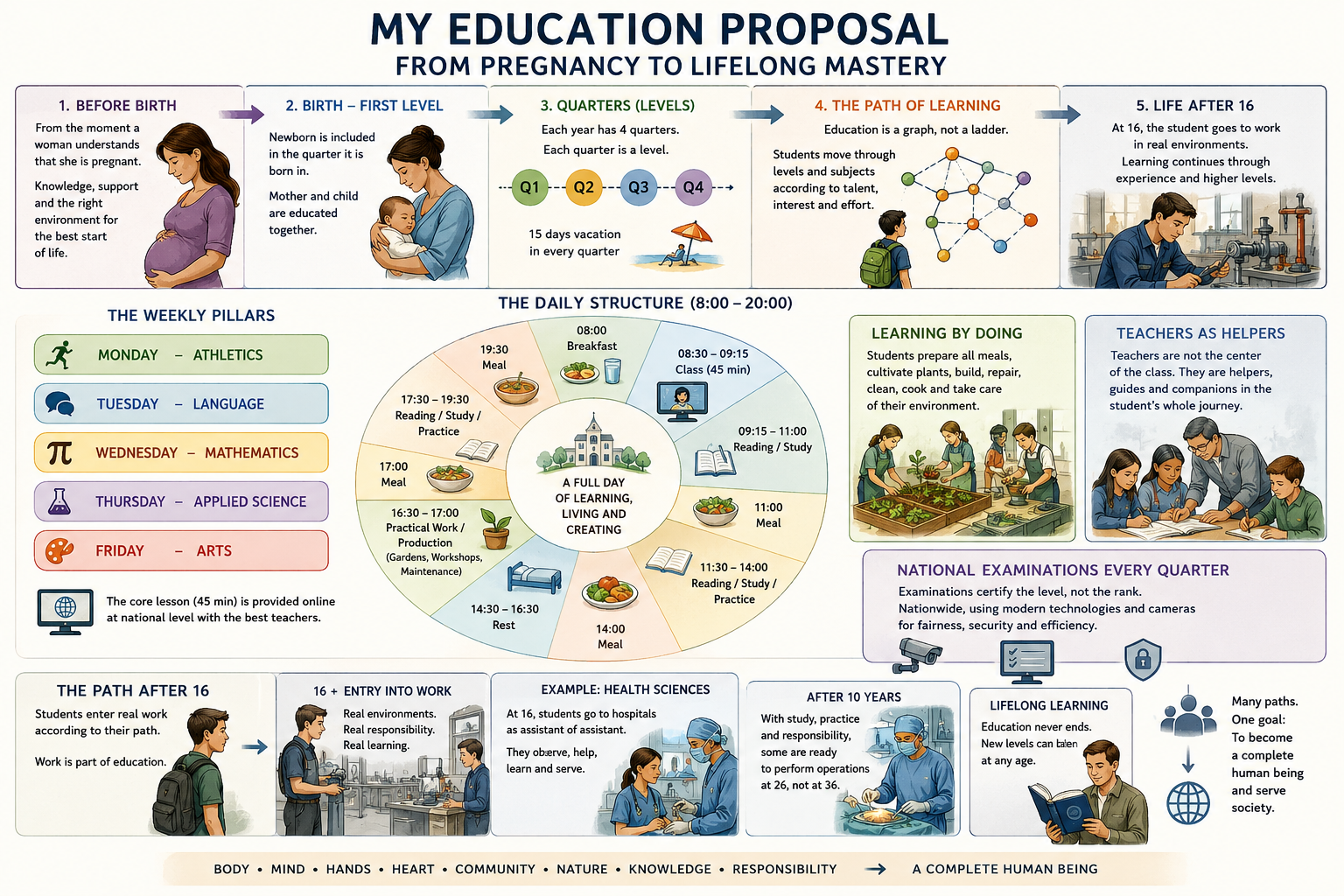
    I propose a different view. Education should begin from the moment a woman understands that she is pregnant. It should continue from birth, through childhood, adolescence, work, and adult life. It should not be a narrow school system. It should be a complete system of human formation.

    The purpose of education is not to produce students who can repeat information. It is to form human beings who can think, speak, count, work, cultivate, build, create, cooperate, defend, and find their own road.

    From the moment of pregnancy, the mother must be given knowledge, support, and the right environment so that the embryo develops under the best possible conditions. Society must not wait until the child is six years old to become interested. The first educational responsibility begins before birth.

    After birth, the newborn is included in the educational quarter into which it is born. This is the first level of education. At this stage, mother and child are educated together. The mother is supported, the child is observed and cared for, and education becomes part of life from the first day.

    The basic unit of the system is the quarter. Every year has four quarters, and every quarter is a level. Each quarter includes 15 days of vacation. The old idea of a school “class” is abolished. Education is no longer a rigid staircase where all children of the same age are forced to move together. It becomes a graph: a network of paths, levels, subjects, talents, and choices.

    Each educational subject has levels: 1, 2, 3, and so on. A student attempts a level. If they master it, they move forward. If they do not, they may try again later or choose another path. There is no humiliation in this. There is no permanent failure. There is only movement, discovery, and development.

    The week has a clear structure.

    Monday is dedicated to Athletics.

    Tuesday is dedicated to Language.

    Wednesday is dedicated to Mathematics.

    Thursday is dedicated to Applied Science: physics, chemistry, biology, technology, engineering, agriculture, medicine, and every practical science of reality beyond language and mathematics.

    Friday is dedicated to the Arts.

    This structure is simple, but inside it the possibilities are enormous. The central lesson of the day lasts 45 minutes and can be provided online at national level. This means that the best available teaching material can reach every school. It also means that there can be hundreds of classes and levels, so that the system can adapt to the talents of each student.

    Teachers, in this system, stop being the central authority standing in front of a class. They become helpers in the student’s whole effort to learn. They guide, support, explain, observe, encourage, correct, and help each student move through the graph of knowledge. The teacher is no longer the owner of the lesson. The teacher becomes the assistant of learning.

    The school day runs from 8:00 in the morning to 8:00 in the evening. This may sound long only because we imagine school as passive sitting. But this is not passive schooling. It is a full educational community.

    The day begins with breakfast at 8:00. Meals are also taken at 11:00, 14:00, 17:00, and 19:30. From 14:30 to 16:30 there is rest.

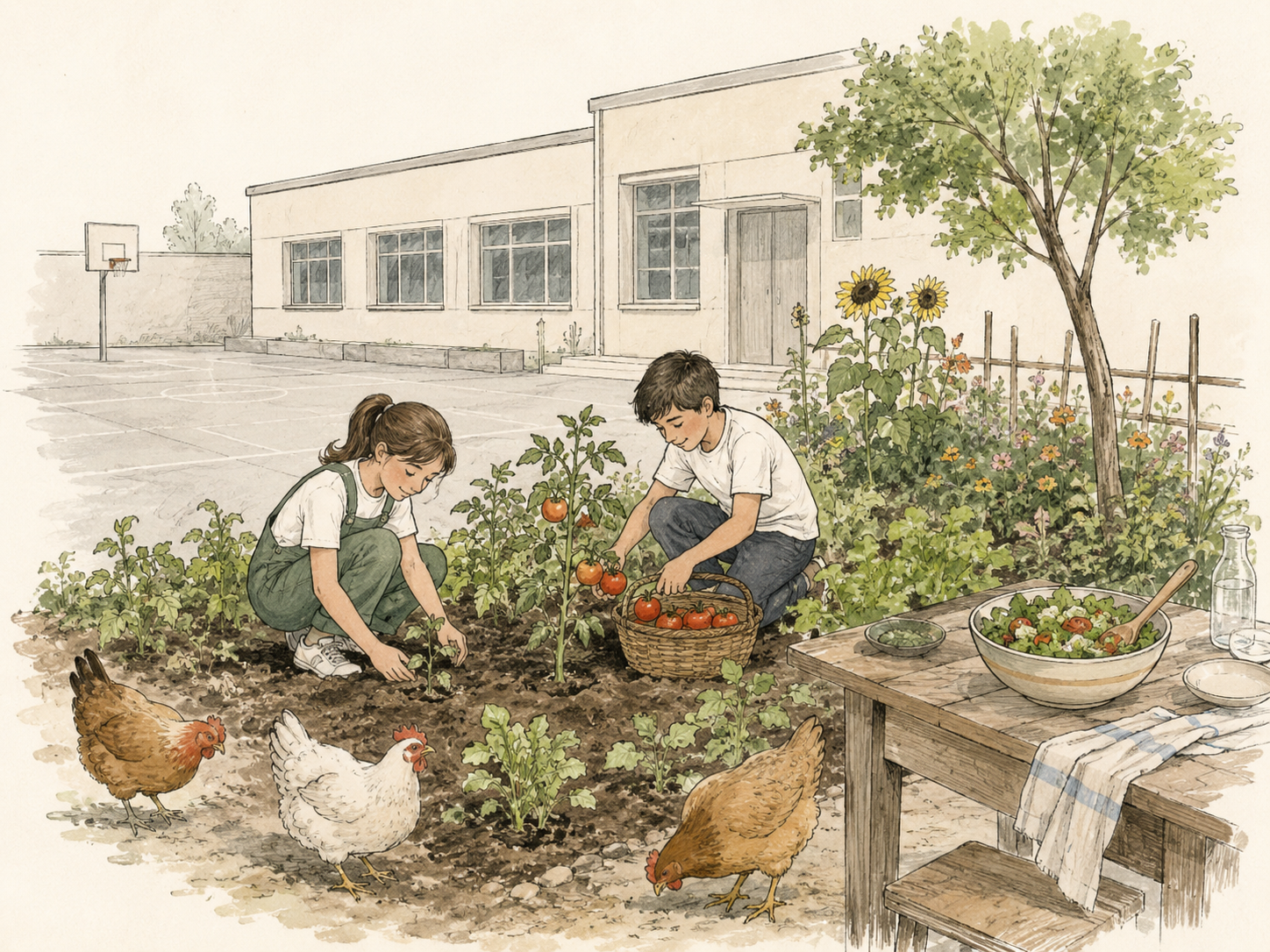
    The students prepare the meals themselves, according to age and ability. They also cultivate as many plants as possible for use in those meals. The schoolyard should not be a dead cement surface. It should be a garden, a kitchen, a workshop, a place of production, maintenance, responsibility, and cooperation.

    Children must learn to plant, cook, clean, repair, paint, build, use tools, maintain their environment, and serve the common life of the school. These are not secondary activities. They are part of education. A society that keeps children sterile for years and then complains that young people cannot do manual work has failed before it even begins to complain.

    Every day includes the 45-minute central class and four hours of reading, study, practice, and guided work. Knowledge is not absorbed by listening alone. It must be worked on. It must be repeated, tested, applied, discussed, and connected with life.

    Athletics is not entertainment. We cannot build skills on a sick or neglected body. The body must be trained, strengthened, disciplined, and respected. Sport, endurance, martial arts, and physical education are foundations of courage, confidence, and will.

    Language is not only communication. It shapes perception. A person sees the world partly through the language they possess. Therefore, the mother tongue must be deeply cultivated, important international languages must be taught seriously, and older linguistic forms should be studied wherever they preserve deeper ways of thought.

    Mathematics trains precision, structure, proof, relation, and abstraction. Without mathematics, the mind remains trapped in impressions.

    Applied science connects the student with the material world. Physics, chemistry, biology, agriculture, medicine, engineering, and technology teach that reality has laws. Nature is not an opinion. Matter resists fantasy. This is an essential lesson.

    The arts complete the human being. Music, drawing, theater, sculpture, architecture, dance, literature, and design cultivate expression, form, beauty, rhythm, and sensitivity. A civilization without art becomes mechanical. A person without art becomes poorer.

    At the end of each quarter, there are national examinations for the relevant levels. These examinations do not exist to rank children permanently or to create one artificial final number. Their purpose is to certify whether a level has been mastered.

    Modern technology can make this system efficient. Online platforms, secure digital examination systems, cameras, identity control, and national coordination can help create fair, transparent, and scalable examinations. The point is not to terrorize students. The point is to make the certification of levels reliable and nationally comparable.

    The grade itself is not the important thing. The important thing is whether the level is acquired. Those who acquire it continue. Those who do not can try again in another quarter or later in life. One bad week, one illness, one family tragedy, one period of anxiety, or one moment of bad luck should not decide a human life.

    By the age of 16, the student should not remain imprisoned in artificial schooling. At 16, the student begins to work.

    This does not mean being thrown unprepared into the market. It means entering real fields of activity according to the levels already acquired. A student qualified for health sciences goes to hospitals. They do not perform operations. They start as the assistant of an assistant. They observe, help, serve, learn, and gradually enter the real environment of medicine.

    After years of serious work, study, practice, examinations, and responsibility, some of them may perform operations at 26. Not at 36. A society that delays real responsibility for too long wastes human energy. Of course, responsibility must come gradually and safely. But it must come early enough for talent to mature inside reality, not outside it.

    The same applies to other fields. The future engineer must enter real construction and technology. The future farmer must enter real cultivation. The future artist must enter real creation. The future lawyer must enter real legal work. The future teacher must enter real educational assistance. The future scientist must enter real laboratories and research environments.

    Work is not the opposite of education. Work is part of education.

    This is why the system must be lifelong. A person should be able to return to levels later in life. Education should not end at 18, 22, or 25. It should remain open. A human being changes. Talent appears late as well as early. The educational graph must remain available.

    In this proposal, universities as we know them lose their old role. The future belongs to Research Centers. Their role is not merely to give degrees, but to produce research, create educational material, support the national teaching system, design levels, renew knowledge, and connect advanced learning with real work.

    The philosophy behind all this is simple: education must stop being sterile.

    It must stop separating the child from the body, from food, from nature, from language, from tools, from work, from responsibility, from community, from beauty, from courage, and from reality.

    A real education begins before birth. It supports the mother. It welcomes the newborn. It forms the child through quarters of life and knowledge. It allows the student to move through a graph of paths. It uses national teaching material, local helpers, practical work, physical training, artistic cultivation, scientific thinking, and real examinations.

    It does not ask every child to become the same person.

    It gives every child the chance to find their road.

    The aim is not merely to create professionals. The aim is to create complete human beings: people who can think, speak, count, cultivate, cook, build, repair, create, defend, cooperate, endure, and serve a living community.

  • How Idiotic Can a System Be When It Decides University Entrance in One Week?

    How Idiotic Can a System Be When It Decides University Entrance in One Week?

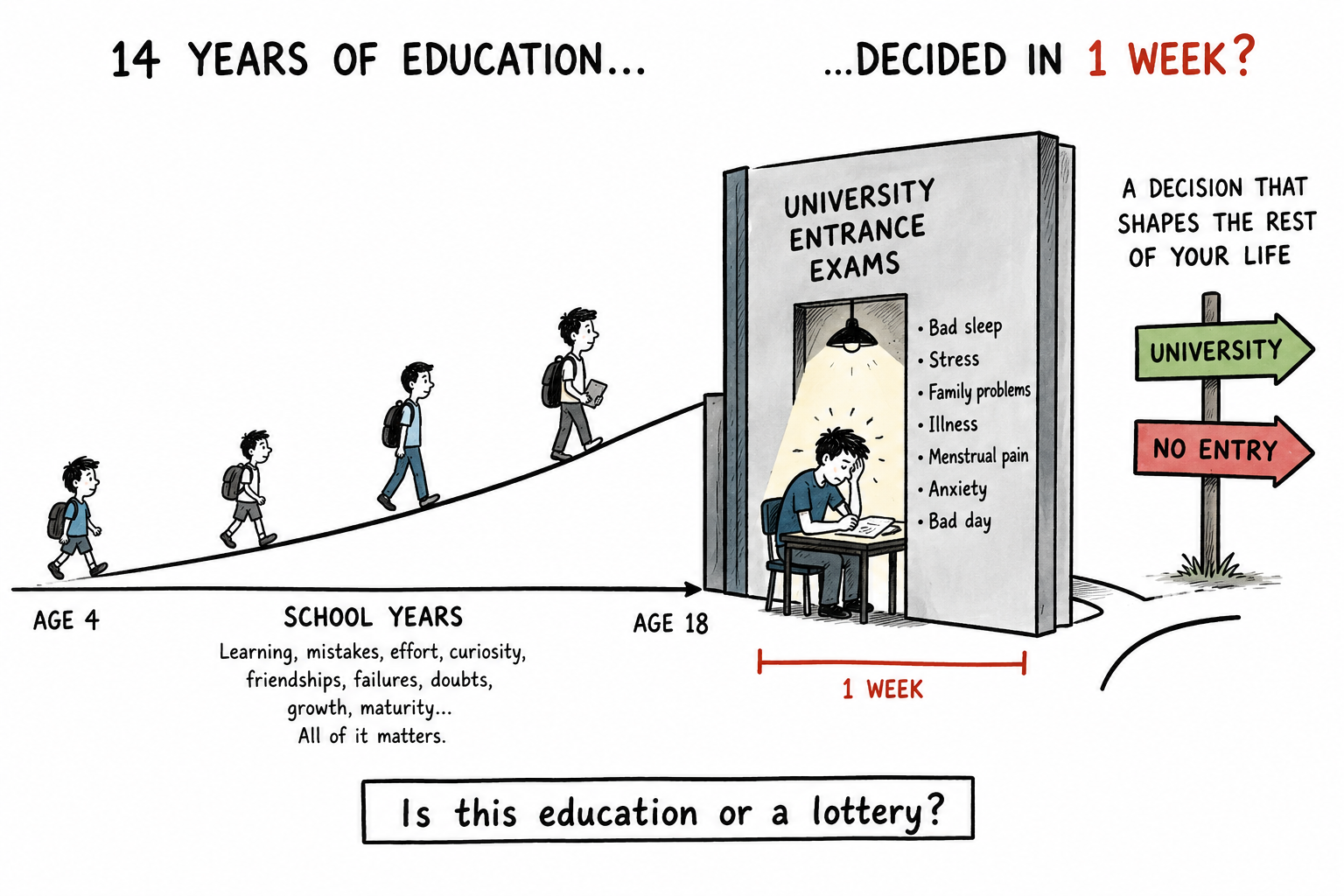
    A society takes a child at the age of four, keeps that child inside an educational system until the age of eighteen, and then, at the end, behaves as if it knows almost nothing about the student.

    After fourteen years of schooling, it asks the student to sit for a few examinations, usually within one narrow period, and from this compressed moment it decides university entrance. This is not wisdom. It is not serious evaluation. It is administrative convenience disguised as meritocracy.

    Of course, exams may be necessary. A society needs some way to decide who enters which university department, especially when places are limited. But the question is not whether there should be evaluation. The question is whether it is rational, fair, or even human to decide so much of a young person’s future through a few exam papers written in one week.

    A student may have worked seriously for years. They may have understood deeply, improved slowly, developed discipline, curiosity, judgment, and maturity. But if they sleep badly the night before the exam, if there is tension in their family, if they are ill, if they are psychologically exhausted, if their environment is unstable, the system does not care. The system says: perform now.

    For girls, there is another obvious issue that is almost never discussed seriously: the menstrual cycle. Pain, fatigue, poor sleep, discomfort, or emotional pressure may affect concentration during those critical days. This does not mean that girls are less capable. It means that students are human beings with bodies, not machines that produce identical performance on command.

    So the examination system does not only measure knowledge. It measures timing, sleep, stress tolerance, family conditions, physical condition, and luck. A student is not judged only by what they know, but by whether their body and life happen to cooperate during a tiny window of time.

    There is also another truth: the system does not trust teachers. And, in many cases, it is right not to trust them as final examiners. Teachers are not always objective, not necessarily because they are dishonest, but because they are human. They know the students personally. They may be influenced by sympathy, behavior, parents, school culture, pressure, habits, or their own grading standards.

    One teacher’s 18 may be another teacher’s 14. Every teacher may have a different system of judgment. This creates injustice. But you do not solve one injustice by creating another.

    If teachers are not reliable as final judges, then the answer cannot be to ignore twelve or fourteen years of education and decide everything in a few final exams. A teacher should teach. A teacher should guide, correct, observe, and help the student grow. But the teacher should not be the final examiner who determines the student’s future. Teaching and final selection are different roles.

    Still, even this is not the deepest problem.

    The deeper problem is the blind belief that grades from different subjects can simply be added together. A student gets 14 in mathematics, 18 in physics, 14 in chemistry, and 18 in language. Then the system adds these numbers, perhaps with weights, and produces a final value. But what exactly has been added?

    Can mathematical ability, physical reasoning, chemical knowledge, and language expression be reduced to one common substance? Are these numbers really the same kind of thing? Even inside mathematics, can geometry and number theory be averaged as if they are identical abilities? This is like saying: I have two apples in one hand and four pens in the other, so on average I have three what per hand?

    Numbers create the illusion of precision. But not every number represents something that can be meaningfully added. A grade is not a kilo, not a meter, not a euro. It is a judgment. And when different judgments about different human abilities are mixed into one final score, the result may look scientific while being philosophically absurd.

    This is why the system is not merely harsh. It is intellectually weak.

    It does not know how to evaluate students over time.
    It does not trust teachers.
    It does not separate teaching from final examination.
    It does not respect the biological and psychological reality of students.
    It pretends that different abilities can be added into a single number.
    And then it calls this justice.

    I will not present here a solution, because my objections are more fundamental. Before discussing a better mechanism, we must first admit that the current logic is broken. We must stop pretending that a one-week examination period can summarize a human being’s educational journey.

    And at every possible turn, politicians again fail. They inherit a bad system, defend it as objective, fear changing it, and leave young people to carry the burden of their cowardice. They do not solve the problem. They preserve it. And then they call it education.

  • Traffic Jams Show Politicians Who Don’t Care or Don’t Dare

    Traffic Jams Show Politicians Who Don’t Care or Don’t Dare

    Traffic jams should not be accepted as a normal part of modern life.

    A temporary delay after an accident, a storm, or a special event is understandable. But daily traffic jams, repeated every morning and every afternoon, are not natural phenomena. They are not acts of God. They are evidence of bad organization.

    They show a political failure.

    A traffic jam is not only a road problem. It is a time problem, a coordination problem, and finally a governance problem. Too many people are allowed — and often forced — to move at the same time, toward the same areas, using the same roads, usually each person alone inside a private vehicle.

    The result is absurd. Millions of people lose hours of their lives sitting inside cars. Energy is wasted without producing movement. People arrive at work already tired and return home already irritated. Families lose time. Businesses lose productivity. Cities become less human.

    And still, society treats this as normal.

    But why should it be normal?

    If a water system failed every morning, politicians would be blamed. If the electricity grid collapsed every afternoon, politicians would be blamed. If schools opened every day with no teachers, politicians would be blamed.

    But when the road system collapses every day, we call it “traffic.”

    This is too soft. A daily traffic jam is a daily collapse of public coordination.

    The usual answer is to build more roads. But more roads are not the real solution. A city can never satisfy unlimited car movement at the same time. Roads are limited public space. They have capacity. When more cars enter than the system can absorb, congestion is inevitable.

    The real question is not only how many roads we have. The real question is: why do we allow too many vehicles to enter the road network at the same moment?

    Traffic lights already exist to control traffic. But they control traffic too late. They act at junctions, after the car has already entered the system. By then, the congestion may already have been created.

    The traffic light must move closer to the real source of the problem.

    It must move to the driver’s starting point.

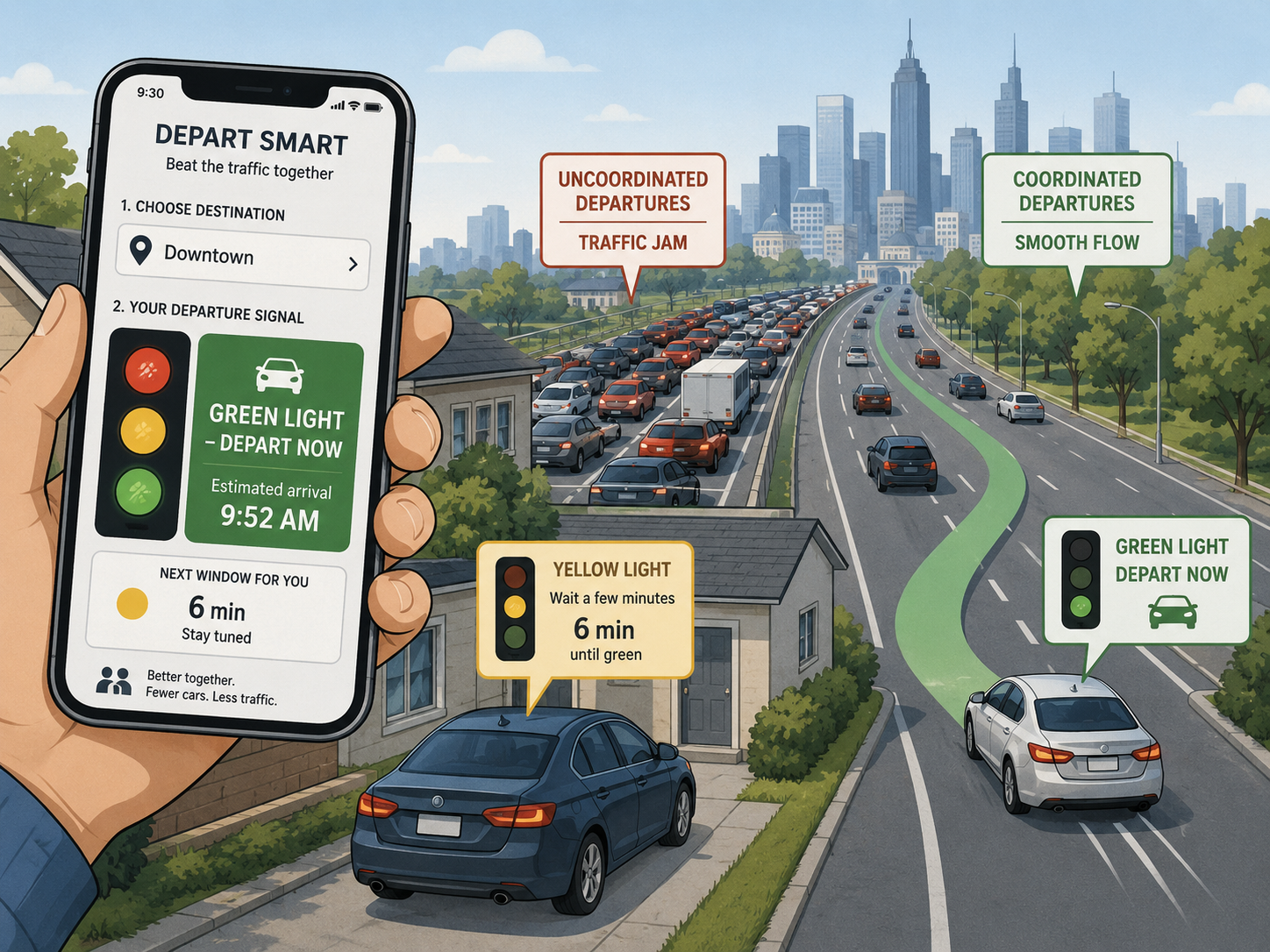
    In a modern city, each private car journey could begin with a digital departure signal on the driver’s mobile phone. The driver declares the destination. The starting point is already known through geolocation. The system checks the current and expected traffic along the relevant route, the available road capacity, and the number of other drivers waiting to depart.

    Then it gives a signal.

    Green: you may start now.

    Yellow: prepare; departure will probably be allowed soon.

    Red: wait; your departure would worsen congestion.

    This is not simply navigation. Navigation tells the driver which route to follow after the trip has begun. This system controls whether the trip should begin now at all.

    It is a personal traffic light.

    The principle is simple: do not allow cars to enter the road network faster than the road network can absorb them.

    Today, the system allows unlimited departures into limited roads. Then, when the roads are overloaded, everyone stops. This is irrational. It is like allowing too many people into a building and then being surprised that nobody can move inside.

    A city should manage road access before the jam is created, not only after it appears.

    This system would also need prediction. A red signal should not feel like blind punishment. The driver should be told: “Estimated green light in seven minutes.” The phone can warn the driver when the green signal is approaching, so they are ready to depart.

    This changes the psychology of waiting. The driver is not trapped in a meaningless delay. The driver is part of a coordinated queue.

    Of course, the system must also prevent abuse. If drivers declare false destinations just to get faster permission, the system becomes useless. So it must check whether the driver starts when green is given and whether the vehicle moves toward the declared destination in a plausible time.

    This does not require public exposure of private data. It requires controlled use of data by the traffic authority. The destination is not shown to other citizens. It is used only to allocate road capacity.

    Some people will object that this violates privacy. But private car use inside a congested city is not purely private. A car uses public road space. It delays others. It pollutes the air. It occupies capacity that belongs to everyone.

    So the principle should be clear:

    The more public road capacity a person consumes, the more coordination that person must accept.

    Walking should not need declaration. Cycling should not need declaration. Public transport should not need personal route declaration. A passenger who wants more privacy can use public transport or a taxi. But a private car travelling through congested public roads is a public-capacity request.

    Society has the right to coordinate it.

    There should also be exceptions. Emergency vehicles, medical emergencies, police, fire services, and other urgent cases must be treated differently. The purpose is not to freeze society. The purpose is to prevent millions of unnecessary, simultaneous departures from destroying the road network every day.

    This system could begin gradually. It could first apply only to busy zones and peak hours. It could begin with incentives rather than penalties: cheaper parking, lower road fees, or priority access for those who obey the departure signal. Later, in heavily congested areas, it could become mandatory for private cars.

    Large traffic generators should also be included: companies, schools, universities, shopping centers, public services, and delivery fleets. They should not all create movement at the same hours. A city should manage time as seriously as it manages space.

    But time distribution alone is not enough. Staggered work hours may reduce congestion, but they do not guarantee that jams disappear. The stronger solution is real-time departure permission.

    A city that can see its traffic in real time should not behave as if it is blind.

    Modern technology already allows route prediction, geolocation, traffic analysis, and instant communication with drivers. The missing element is not technology. The missing element is political will.

    This is why traffic jams reveal something deeper about politicians.

    Either they do not care enough about the lost time, stress, pollution, and daily humiliation of citizens.

    Or they do not dare to challenge the idea that everyone should be able to start a private car journey whenever they wish, even if that destroys the mobility of everyone else.

    Traffic jams are not proof that cities are too alive. They are proof that cities are badly coordinated.

    A serious state would not accept daily congestion as normal. It would treat it as a failure of public management. It would measure road capacity, control departures, protect privacy where possible, create exceptions where necessary, and prevent ordinary jams before they form.

    The goal is not to punish drivers. The goal is to respect everyone’s time.

    A traffic jam is not freedom. It is the result of millions of uncoordinated freedoms cancelling each other.

    Real freedom is movement that actually works.

    And if politicians continue to tolerate daily traffic jams, then the conclusion is simple: they either do not care, or they do not dare.

  • Veganism is a Result of Bad Education

    Veganism is a Result of Bad Education

    Veganism is usually presented as a moral choice, a health choice, or an environmental choice. But there is another way to see it: veganism is often a result of bad education.

    Not bad education in the narrow sense of poor grades or weak schools. Bad education in a deeper sense. An education that separates the human being from the natural processes that sustain life. An education that fills the mind with abstractions, slogans, and moral judgments, while leaving the hands empty of soil, tools, plants, animals, and real responsibility.

    Modern society has become sterile. The schoolyard is often cement. The classroom is often closed. The child sees screens, books, plastic packages, supermarket shelves, and moral messages, but rarely sees a hen laying an egg, a goat giving milk, a bean growing from the soil, or a tomato plant needing care, water, sun, and protection.

    How can a person judge food, animals, nature, and agriculture without having touched the chain of life that produces food?

    A child should not learn about food only from labels, documentaries, activists, advertisements, or nutrition charts. A child should plant tomatoes, see them grow, understand that they may get sick, learn that they may need treatment, collect them, cut them, make a salad, and eat it. This is not merely agricultural training. It is human education.

    Students should be partly farmers and partly cooks. They should learn that food comes from life, time, work, care, failure, weather, soil, insects, animals, and human effort. They should understand that nature is not a clean moral symbol. Nature is living, generous, harsh, dirty, beautiful, and practical.

    When education removes children from this reality, it creates personalities that can speak morally about nature without having lived near nature. It creates people who are sensitive, but abstract. Compassionate, but detached. Full of opinions, but poor in experience.

    This is why veganism grows so easily in modern urban societies. It is not simply that some people love animals. That is understandable. It is that many people have been educated far away from the real conditions of food production. They know the supermarket, not the farm. They know the image of the animal, not the animal. They know the package, not the process.

    Of course, a person raised on a farm can still become vegan. Direct contact with animals may lead some people to reject animal products. But this would be a choice made after contact with reality. It is very different from a moral conclusion formed inside a sterile system, where the child has never seen how food actually comes into existence.

    The same error appears in the way society treats smartphones. The state sees that children are absorbed by screens, so it tries prohibition. It says: do not use the phone. But it does not ask the deeper question: why is the phone so attractive?

    The phone wins because the real world offered to the child is often empty. Cement instead of soil. Sitting instead of working. Screens instead of animals. Theory instead of practice. Consumption instead of production. When children are not given real things to do, they naturally escape into artificial things.

    The state tries to remove smartphones from children’s hands, but it does not put soil, seeds, tools, animals, cooking, music, craft, and responsibility into those hands.

    This is a failure of the whole system, not only of the school. Modern society violates the deep nature of the human being. Human beings were not formed by evolution to sit for endless hours under artificial light, surrounded by cement, consuming digital stimulation, eating food made invisible by industry, and forming moral opinions about life without participating in life.

    The human being needs contact with the real: soil, plants, animals, family, community, work, risk, hunger, cooking, birth, death, seasons, silence, and responsibility. When these are removed, personality is distorted. Then experts study the distorted personality as if it were normal, while ignoring the unnatural system that produced it.

    Veganism, in this sense, is not the main problem. It is a symptom. It is one visible result of an education that has lost contact with life. A society that hides the farm, hides the animal, hides the field, hides the kitchen, and hides labor should not be surprised when its children develop abstract moral ideas about food.

    A real education would not be sterile. A real school would have soil, plants, hens, perhaps goats, perhaps even a cow where possible. It would have gardens, kitchens, workshops, and living responsibility. Children would not only learn about nature. They would participate in nature.

    They would plant, care, harvest, cook, and eat. They would learn that food is not an object. Food is a relationship between life and life.

    That kind of education would not necessarily make every child eat meat, eggs, or milk. But it would make every child more grounded. Their choices would come from experience, not from distance. From participation, not abstraction. From reality, not sterility.

    Veganism is a result of bad education because bad education has separated human beings from the living world that feeds them. It has taught them to judge life before teaching them to live within it.

  • Every Vehicle Owner Should Be Reachable Through the License Plate

    Every Vehicle Owner Should Be Reachable Through the License Plate

    A vehicle is private property, but when it enters public space it is no longer only a private object. It moves among other people, occupies streets, blocks entrances, uses public roads, creates risks, and can affect the lives of strangers. For this reason, society already imposes many duties on vehicle owners: registration, insurance, roadworthiness checks, taxes, parking rules, speed limits, and traffic laws.

    There is one more duty that modern states should consider: every vehicle owner should be reachable through the license plate, without revealing their identity or personal data.

    This does not mean that anyone should be able to discover who owns a car. It does not mean that a citizen should enter a license plate number and receive the owner’s name, address, or phone number. That would be dangerous and unacceptable.

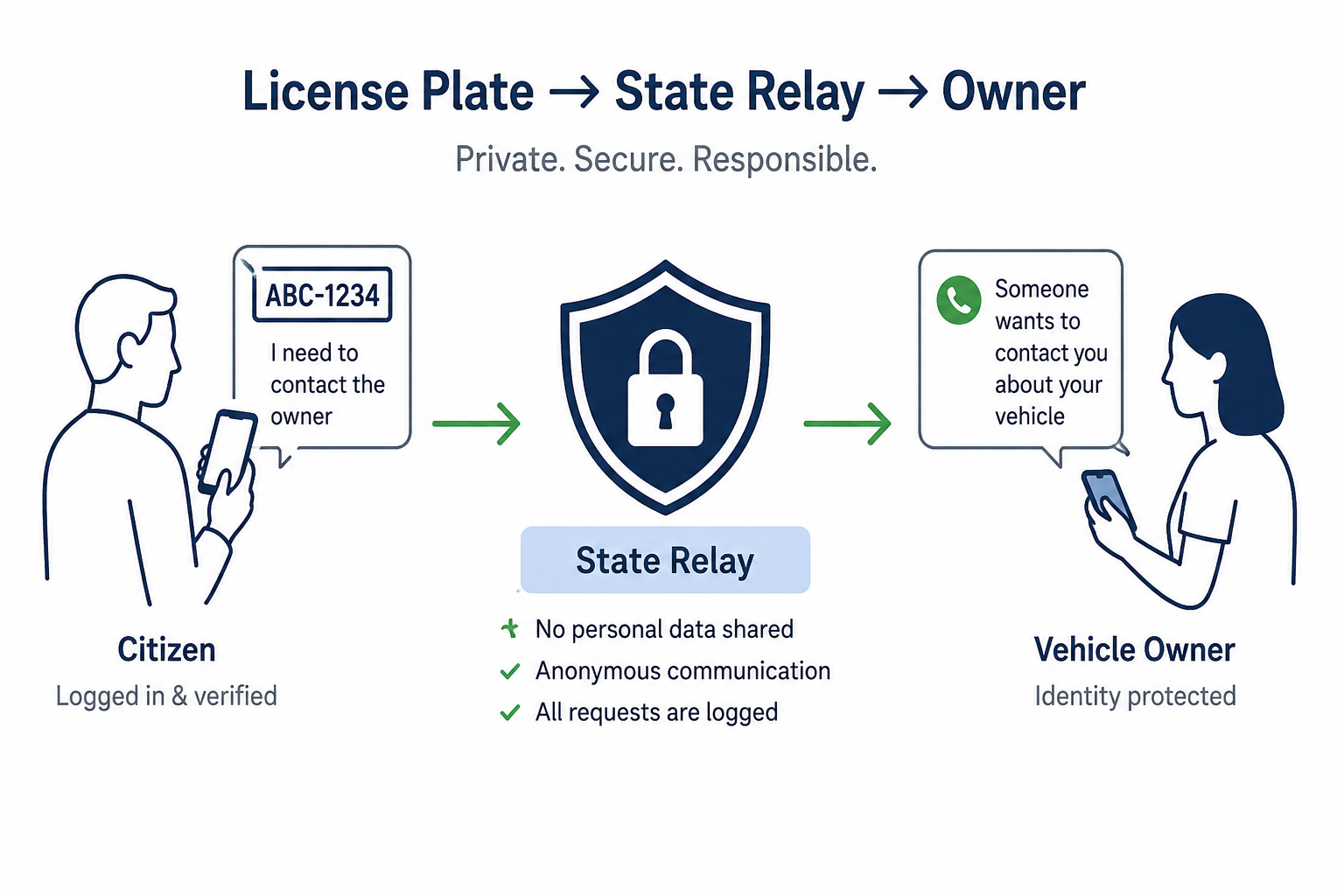
    The idea is different. The state should create an official communication relay. A citizen enters a license plate number into a state app, selects the reason for contact, and the system connects them to the vehicle owner through a masked call, message, or notification. The caller never sees the owner’s phone number. The owner never needs to reveal their identity. The state simply creates a controlled bridge between the vehicle and the person responsible for it.

    The need for such a system is obvious in everyday life.

    A car blocks a garage.
    A car blocks another parked car.
    A car has its lights on.
    A window is open.
    An alarm is ringing.
    A vehicle has been damaged.
    A child or animal may be inside.
    A car is parked in a dangerous position.
    Something is leaking from the vehicle.
    A citizen sees a problem before it becomes a bigger problem.

    Today, in many of these cases, people have no practical way to contact the owner. They may wait, shout, leave a note, call the police for a minor issue, or do nothing. This is inefficient. It wastes public resources, creates conflict, and sometimes allows small problems to become serious ones.

    A state relay system would solve this simply.

    The citizen would log in with a verified identity. They would enter the license plate number and choose the reason for contact. The vehicle owner would receive a message such as: “A verified citizen is trying to contact you about your vehicle.” The owner could accept the call, reject it, reply by message, or report misuse.

    This is important: the owner’s privacy would be protected, but the caller would be accountable. The caller would not be anonymous to the state. Every contact attempt would be logged. Repeated false reports, harassment, or abusive use could lead to penalties.

    So the correct balance is this:

    The vehicle owner should be anonymous to the citizen, but reachable through the state.
    The citizen should be unknown to the vehicle owner if necessary, but known to the state.
    The state should not expose private data, but should enable responsible communication.

    This system would also reduce unnecessary police involvement. Many vehicle-related problems do not require police action. They require only communication. If a car is blocking someone for five minutes, the best solution is not bureaucracy. The best solution is to reach the owner quickly. If the owner responds, the problem is solved. If the owner ignores repeated contact, then escalation to municipal police or traffic authorities becomes justified.

    The license plate is already the public identifier of the vehicle. It is visible because society needs a way to connect a vehicle to responsibility. But visibility should not mean exposure. A license plate should not open a door to personal information. It should open a controlled door to responsible contact.

    Of course, such a system would need safeguards. It should not be a toy for angry drivers. It should not allow unlimited calls. It should not allow anonymous harassment. It should not become a public directory of car owners.

    The app should have clear rules: verified users, limited contact attempts, predefined reasons, abuse reporting, blocking options, emergency escalation, and penalties for misuse. It should also allow the owner to choose preferred contact modes, such as call, message, or push notification.

    The principle is simple: when your vehicle is in public space, society should be able to reach you about that vehicle. Not to invade your privacy. Not to expose your identity. Not to create a new form of surveillance. But to solve practical problems that already exist every day.

    A modern state should not treat a parked vehicle as a silent object with no reachable responsible person behind it. A vehicle can affect strangers, and when it does, there should be a safe way to contact the person responsible.

    Every vehicle owner should be reachable through the license plate — not publicly identifiable, not personally exposed, but responsibly reachable through an official state relay.

    That would be a small technological change, but a large civic improvement.

  • Should a Housewife Pay Taxes for Her Work at Home?

    Should a Housewife Pay Taxes for Her Work at Home?

    At first sight, the answer seems simple: no.

    A housewife should not pay income tax for her work at home, because she receives no income. She cooks, cleans, raises children, cares for elderly relatives, organizes the household, supports the working spouse, and often performs many invisible tasks that would cost a great deal of money if bought from the market. But she is not paid a salary. Therefore, there is no income to tax.

    To tax unpaid domestic work as if it were income would be absurd. It would require the state to enter the private home and estimate the value of cooking, cleaning, emotional support, child care, care for the elderly, family administration, and countless daily acts of responsibility. Such a system would be intrusive, arbitrary, and morally wrong.

    But this simple answer does not solve the deeper problem.

    Because although the housewife has no taxable income, her work has real value.

    The question, therefore, is not only:

    Should a housewife pay taxes for her work at home?

    The deeper question is:

    How should a fair tax system treat two households that have the same money income but a different structure of work and time?

    Imagine two married couples.

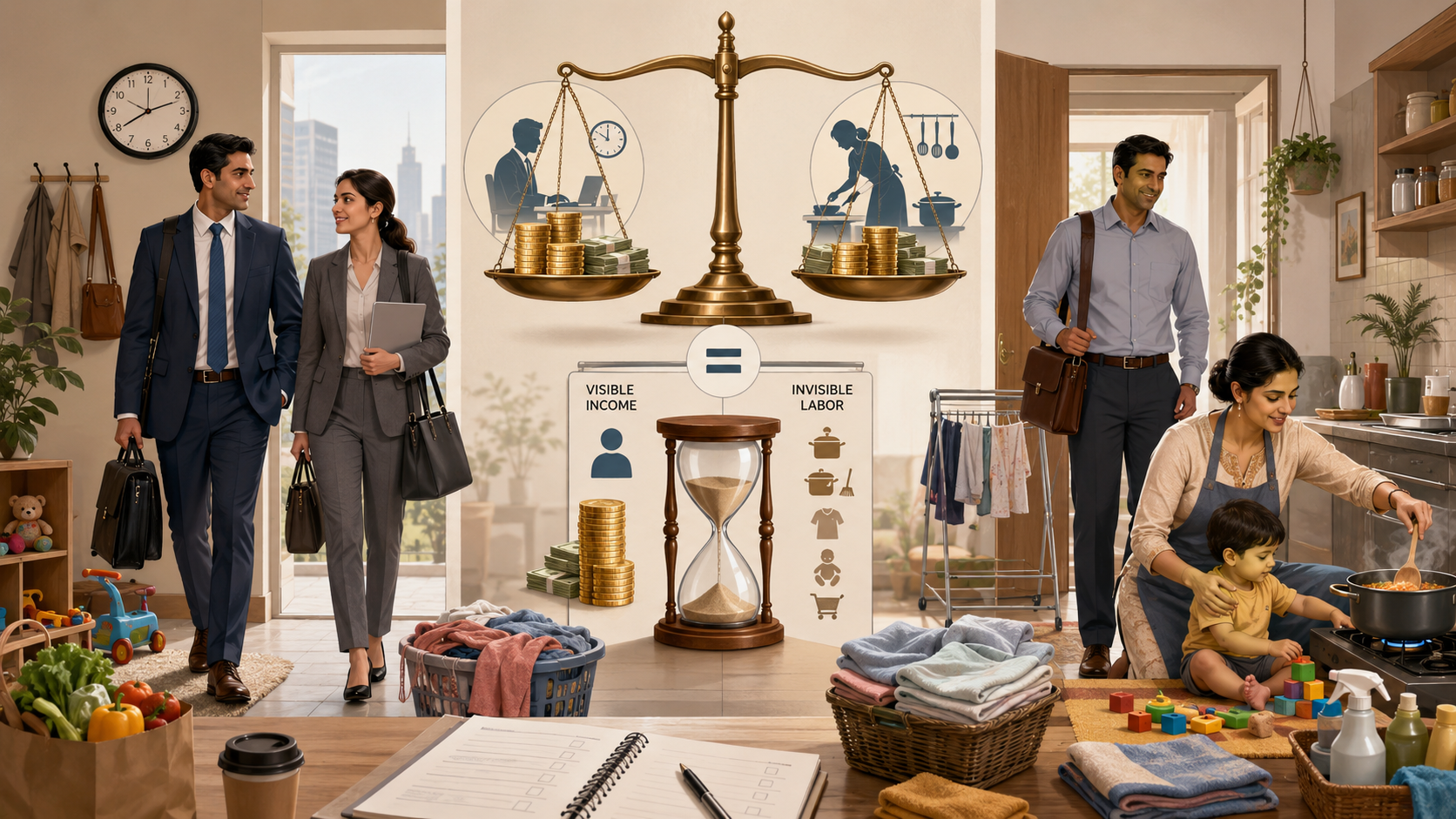
    In the first couple, both husband and wife work outside the home. Each earns $2,500 per month. Together, they earn $5,000.

    In the second couple, only the husband works outside the home and earns $5,000 per month. His wife is a housewife and works inside the home without salary.

    The two households have the same visible income: $5,000.

    So, under a normal tax system, they may be treated almost the same.

    But are they really the same?

    No.

    The first couple has two people selling their time in the market. Both leave the home, work for employers or clients, and return with less time and energy for household work. They may need to buy more services from the market: childcare, prepared food, cleaning help, transportation, or other support. Even if they do not buy these services, they must perform domestic work after paid work, with tired bodies and limited time.

    The second couple has one person earning money and one person producing unpaid household value. The housewife may not bring money into the household, but she reduces the household’s need to spend money. She creates value directly inside the family.

    So the two households have equal money income, but not equal total economic reality.

    This shows the weakness of income taxation.

    Income tax sees only money. It does not see time. It does not see unpaid work. It does not see domestic production. It does not see stress, exhaustion, or the cost of replacing household work with market services.

    The state sees $5,000 and says:

    “These households are equal.”

    But they are not equal in time, labor structure, or household reality.

    Still, this does not mean that the housewife’s work should be taxed.

    Her unpaid work should be respected, not taxed.

    The mistake would be to say:

    “Because the housewife creates value, the state should tax that value.”

    That would be wrong. The home is not a company. Marriage is not a payroll system. Family care is not a taxable transaction. The state should not convert every human act into taxable economic production.

    But the opposite mistake is also serious.

    We should not say:

    “Because the housewife has no income, her work counts as nothing.”

    That is also wrong.

    The fair position is between these two errors.

    The housewife’s domestic work should not be taxed as income, but a fair tax theory must recognize that unpaid household work changes the real economic position of the household.

    This is where the idea of the fair tax becomes important.

    A fair tax should not be based only on visible income. Visible income is only the surface. Behind income there is time, effort, risk, ability, opportunity, and social power.

    Two people may earn the same amount of money, but one may need four hours to earn it while another needs sixteen hours. Their income is equal, but their sacrifice of life is not equal.

    In the same way, two households may have the same income, but one may have two adults exhausted by market work, while the other has one adult earning money and another adult producing value inside the home.

    Their income is equal, but their use of time is not equal.

    So the fair question is not simply:

    “How much money entered the household?”

    The fairer question is:

    “How much civic obligation should each adult carry?”

    In my view, the answer should begin from equal civic time.

    Every adult should have the same basic obligation toward the common good. Not because every adult earns the same money, but because every adult is a member of the political community.

    The housewife should not be taxed for her domestic work. But she should not be considered outside civic obligation either.

    She is not economically useless. She is not socially invisible. She is not a dependent child. She is an adult citizen whose time has value.

    Therefore, in a fair system, both couples should face the same basic civic duty because both households contain two adults.

    But they should not automatically pay the same money tax just because both households show $5,000 income.

    This distinction is essential.

    The fair tax should not say:

    “Both households earn $5,000, therefore both must pay the same.”

    It should say:

    “Both households contain two adult citizens, therefore both owe the same basic civic time. If they want to keep that time private, they may exchange it for money.”

    Under such a system, public service becomes the original obligation, and money becomes only a substitute.

    Each adult owes time to the common good. For example, each adult may owe a certain number of public-service days. These days could be used in hospitals, schools, elderly care, local administration, environmental work, civil protection, digital archiving, public maintenance, or other public needs.

    But if a citizen does not want to serve on those days, he or she may buy them back at an increasing price.

    This creates a more honest system.

    The state no longer needs to pretend that it knows the full economic truth of every household. It does not need to estimate the value of the housewife’s cooking, cleaning, childcare, or emotional labor. It does not need to tax love, care, or domestic responsibility.

    Instead, it says:

    “You owe civic time. If your private time is valuable to you, you may pay to keep it.”

    For the first couple, both working adults may choose to buy back public-service days because their time is already heavily committed to paid work.

    For the second couple, the working husband may buy back his days because his market time produces income. The housewife may serve her civic days, or the household may buy them back because her time at home is valuable to the family.

    In this way, the system does not tax housework directly. But it also does not pretend that the housewife’s time has no value.

    It recognizes her as a full adult citizen with civic obligation, while protecting the home from direct taxation of unpaid domestic work.

    This approach also answers the fairness problem between the two couples.

    Should they pay almost equal taxes?

    Under the current income-tax logic, perhaps yes, because both households have the same visible income.

    But under a deeper theory of fairness, not necessarily.

    The two households should have the same basic civic obligation, because both have two adults. But the final money paid should depend on how much time each household chooses to keep private.

    The fair basis is not equal income.

    The fair basis is equal civic time.

    This also protects the dignity of unpaid domestic work. It says that the housewife’s work is real, but it is not a taxable salary. It says that care has value, but the state should not invade the home to price it. It says that citizenship includes obligation, but not every valuable human act should become taxable income.

    So the answer is:

    No, a housewife should not pay income tax for her work at home.

    But yes, as an adult citizen, she should share the same civic obligation as every other adult.

    The fair tax system should not tax her domestic work. It should not ignore it either. It should begin from equal civic time and allow each household to decide whether to serve that time or buy it back.

    That is fairer than taxing only money income.

    Because money income does not tell the whole truth.

    Time is deeper than income.

    And a fair society should not ask only how much money a person earns.

    It should also ask how much common time every citizen owes to the public good.

  • The Civic Republic

    The Civic Republic

    Modern democracy suffers from a structural weakness that is visible but rarely confronted directly: the absence of an institutional voice that does not calculate political cost.

    In today’s parliamentary system, every elected representative lives under the pressure of re-election. This is natural. A politician who wants to remain in public life must think about voters, parties, polls, media reactions, personal alliances, and future campaigns. But this creates a serious limitation. The political system may know what is necessary, yet avoid it because it is unpopular. It may see the long-term interest of the country, yet sacrifice it for short-term approval.

    For this reason, I propose a new form of polity: The Civic Republic.

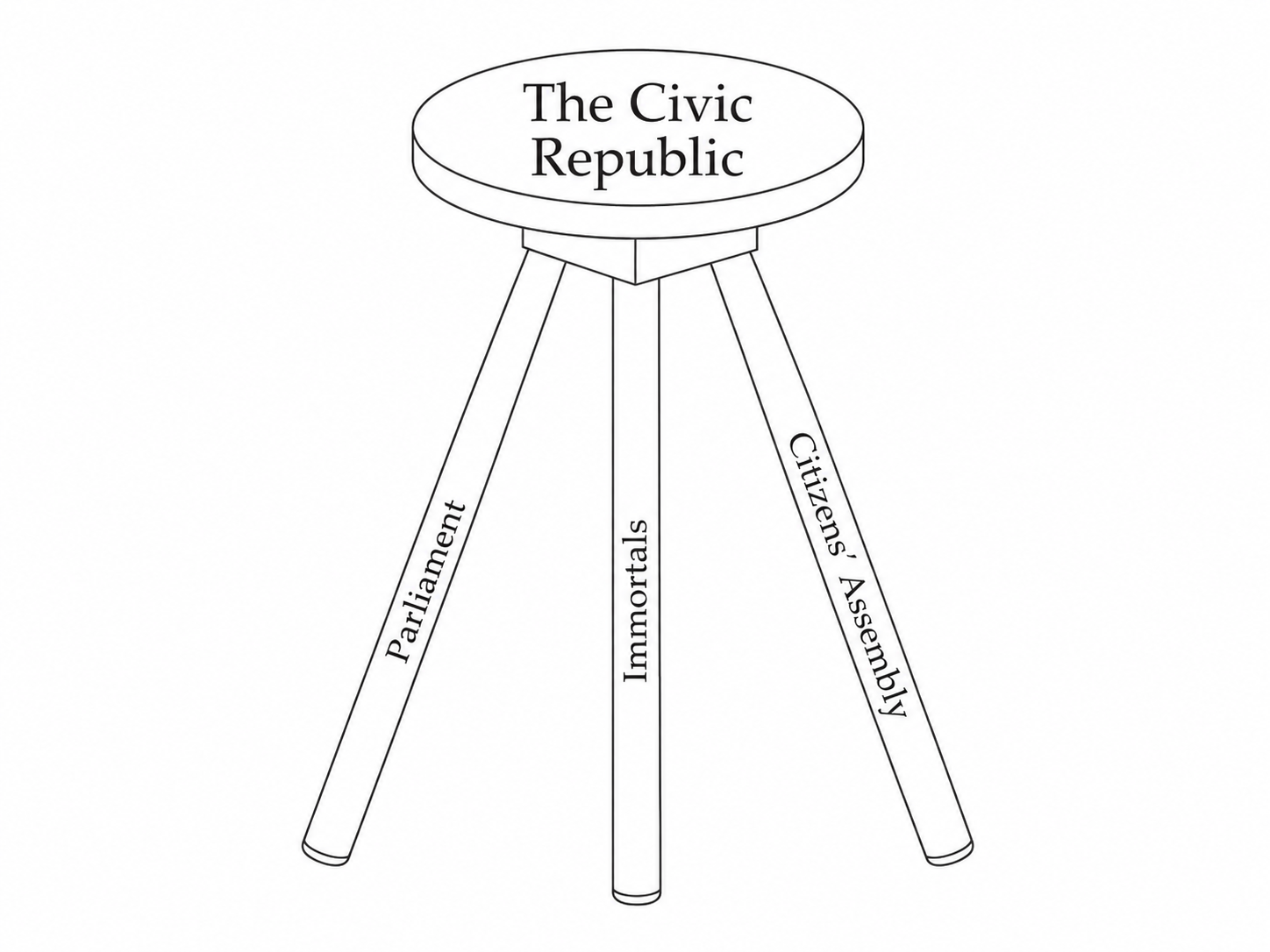
    Its purpose is not to abolish parliamentary democracy, but to complete it. The existing Parliament remains, but legislative power is no longer produced by one body alone. Instead, the legislative function is shared among three bodies:

    1. The Parliament
    2. The Immortals
    3. The Citizens’ Assembly

    Each body expresses a different democratic necessity. Parliament expresses electoral representation. The Immortals express civic judgment without political cost. The Citizens’ Assembly expresses the living experience of ordinary citizens.

    Together, they form a more balanced political system.

    The Parliament

    The first body is the Parliament as we already know it. In Greece today, this means the elected Parliament of 300 members.

    This body continues to exist and continues to play the central role in political life. It represents the organized political will of the people through elections, parties, programs, public debate, and government formation.

    However, in the Civic Republic, Parliament no longer holds the entire legislative weight by itself. It holds 50% of the legislative vote.

    This means that elected representatives remain the strongest body, but they are no longer alone. No law can be understood only as a product of party power or electoral calculation. The remaining 50% belongs to citizens who do not operate under the same political incentives.

    The Immortals

    The second body is the Body of the Immortals.

    This would be a body of 30 citizens who are not elected. They would be citizens over the age of 50, selected according to three hierarchical criteria:

    A. Social conduct
    B. Athleticism
    C. Mathematical ability

    The first criterion, social conduct, is the most important. Athleticism follows. Mathematical ability follows after that. The hierarchy matters because the purpose of the body is not to create a technocracy of clever people, nor an aristocracy of physical strength. The first and dominant requirement is civic character.

    The Immortals are called by this name because the institution does not depend on the personal identity of its members. Thirty historical civic names could be assigned to the seats: Pericles, Solon, Cleisthenes, and others. The person serving in the seat changes, but the civic name remains. In this way, the institution emphasizes continuity, responsibility, and symbolic service to the republic.

    The Immortals would participate in the legislative process with 25% of the total legislative vote.

    Their role is to introduce into the system something that electoral politics cannot easily produce: a voice that has no need to be popular tomorrow. The Immortals do not campaign. They do not seek votes. They do not depend on party approval. Therefore, they can support what they believe is necessary, even when it is uncomfortable.

    A democracy needs such a voice. Not because elected politicians are bad, but because electoral pressure is real. A system that depends only on elections risks becoming a system of permanent fear: fear of reactions, fear of cost, fear of losing power. The Immortals are designed to reduce that fear inside the legislative process.

    The Citizens’ Assembly

    The third body is the Citizens’ Assembly.

    This body would consist of 1,000 citizens selected by lot. Their term would last one month. Every month, 1,000 new citizens would be selected.

    The Citizens’ Assembly would also hold 25% of the legislative vote.

    This body responds to another weakness of modern representative democracy: elected politics often does not hear society directly. It hears what parties choose to present. It hears what organized interests can amplify. It hears what the media decides to highlight. But many real problems remain invisible.

    The Citizens’ Assembly brings ordinary citizens directly into the legislative process. Because its members are randomly selected and constantly renewed, it cannot easily become a closed political class. It is not a party. It is not a profession. It is not a career. It is a rotating civic mirror of society.

    Through the Citizens’ Assembly, the republic hears real citizens before laws are made. It hears their problems, fears, objections, and common sense. It brings the everyday experience of society into the center of legislation.

    A Three-Body Legislative System

    In the Civic Republic, legislative power is distributed as follows:

    Parliament: 50%
    Immortals: 25%
    Citizens’ Assembly: 25%

    This structure creates a new balance.

    Parliament provides democratic continuity through elections.
    The Immortals provide judgment without political cost.
    The Citizens’ Assembly provides direct social experience through random citizen participation.

    A law, therefore, would need support not only from professional politics, but also from citizens outside the electoral mechanism. Half of the legislative weight would belong to people who do not depend on political survival.

    This is the central idea of the Civic Republic: the law should not be produced only by those who fear the next election.

    Why This Is Still Democracy

    Some may object that the Immortals are not elected. But democracy should not be reduced only to elections. Elections are essential, but they are not the only democratic method. Selection by lot also has deep democratic meaning. Civic participation, institutional balance, public responsibility, and protection from concentrated power are also democratic principles.

    The Civic Republic does not remove elections. It limits the monopoly of elections over legislation.

    The elected Parliament still has the largest share of legislative authority. But it must now cooperate with two other civic bodies. One body represents tested civic character. The other represents ordinary citizens selected by chance.

    This creates a democracy that is not only electoral, but also civic.

    The Aim of the Civic Republic

    The aim of this system is not to weaken the people’s will. It is to protect it from distortion.

    The people’s will is not always identical to party strategy. Society’s real needs are not always identical to campaign promises. Long-term justice is not always identical to short-term popularity.

    The Civic Republic tries to solve this by giving institutional power to three different forms of citizenship:

    The citizen as voter.
    The citizen as responsible elder.
    The citizen as ordinary member of society.

    The Parliament, the Immortals, and the Citizens’ Assembly together create a more complete expression of the republic.

    Conclusion

    Every political system has its blind spots. The blind spot of modern parliamentary democracy is that it asks elected politicians to act beyond political cost, while forcing them to live under political cost every day.

    The Civic Republic accepts this contradiction and tries to correct it institutionally.

    It does not expect politicians to become saints. It does not expect parties to ignore power. It does not expect society to be heard automatically. Instead, it designs a system where different kinds of civic voice are structurally present in the making of laws.

    The Parliament brings electoral legitimacy.
    The Immortals bring courage without electoral fear.
    The Citizens’ Assembly brings the direct reality of society.

    This is the proposal of the Civic Republic: a democracy where legislation is not only the work of political power, but the shared work of the republic itself.